
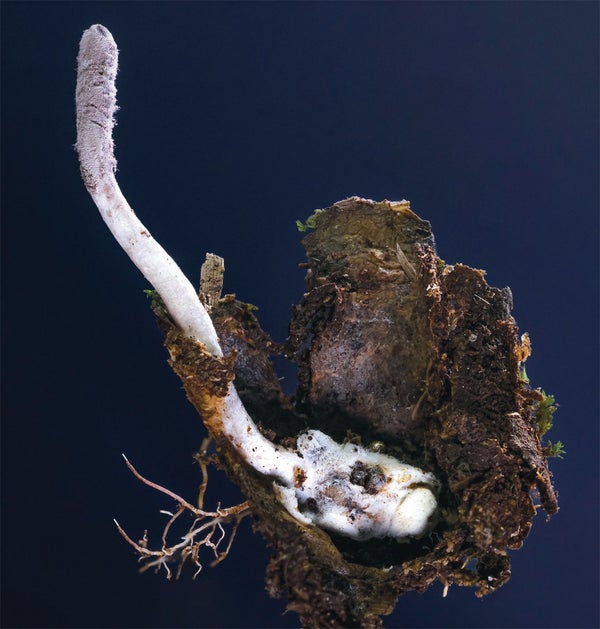
Deep in eastern Brazil's Atlantic Forest, a team of biologists spotted a fuzzy purple stalk protruding from the leaf litter on the ground. Following the spore-covered body down into the soil, they found a mummified spider swaddled in fungal filaments called hyphae.
One of the mycologists, João Araújo, immediately recognized the purple protrusion as a new, undocumented species of predatory fungus belonging to the genus Purpureocillium. Spores from these fungi latch onto and kill their insect or arachnid prey—and then a fruiting body bursts from the corpse to spread more spores.
Purpureocillium species share many similarities with those of their sister genus Ophiocordyceps, which includes the “zombifying” fungi that hijack the bodies of their insect prey and are featured in the apocalyptic television show and video game The Last of Us. Araújo, who works for the New York Botanical Garden, has dedicated his career to discovering new species in this intriguing evolutionary group. “Many of these specimens we collect are new species,” he says. “We know so little about them.”
On supporting science journalism
If you're enjoying this article, consider supporting our award-winning journalism by subscribing. By purchasing a subscription you are helping to ensure the future of impactful stories about the discoveries and ideas shaping our world today.
The “beautiful, velvety” purple specimen would be only the seventh species of Purpureocillium discovered, says Jennifer Luangsa-ard, a mycologist at Thailand's National Center for Genetic Engineering and Biotechnology. These fungi are found across the world and include one species that causes eye and skin infections in immunocompromised people. Scientists know surprisingly little about the fungal kingdom despite its importance for our health, food and environment; according to conservative estimates, only 10 percent of species have been identified, Luangsa-ard says. “We need more people looking for the missing taxa,” she adds. There's “still a lot to be discovered.”
The wild popularity of The Last of Us may lead people to spot new species, which are often hiding in plain sight, Araújo says. He adds that a naturalist recently spotted two potential species of Ophiocordyceps infecting ants at a nature preserve in Pennsylvania, a short drive from Araújo's laboratory. This discovery may allow his team to closely study the still mysterious ways these fungi manipulate and kill their prey.
To see more, visit ScientificAmerican.com/science-in-images