
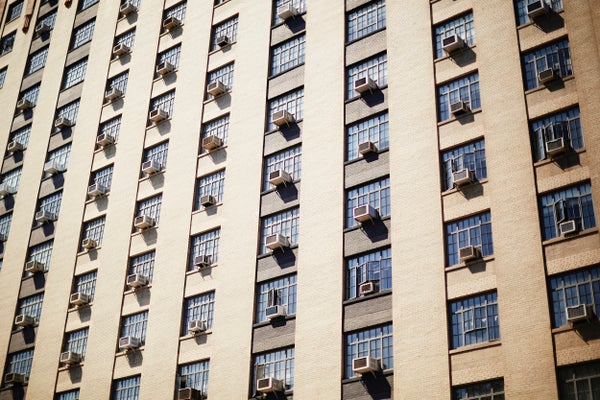
Global economic development, in combination with climate change, is expected to result in over a billion new consumers installing air-conditioning systems in their homes and businesses in the coming decades. The International Energy Agency (IEA) has predicted that by 2050 energy demand for indoor cooling will be 300 percent higher than present-day levels, making cooling by far the largest use of electricity in the global buildings sector. These estimates were made before the COVID-19 pandemic, however. Our research shows that, if the expanded indoor fresh air requirements that were adopted to combat COVID-19 transmission persist after the pandemic, this predicted increase will occur much sooner.
To understand this impending air-conditioning boom, one must acknowledge the historically synonymous, and troublesome, relationships between the terms “air conditioning,” “cooling” and “ventilation.” Air-conditioning (AC) does not necessarily equate to cooling people, and it does not necessarily deliver fresh air. In fact, in a typical “air-conditioned” building more than 50 percent of the cooling you experience has nothing to do with the air temperature, but instead with the temperature of the walls and other surfaces surrounding you. Still, with the majority of us growing up with thermostats that only measure air temperature, these misconceptions have led to a dependence on air-conditioning for comfort.
Since the mid-20th century, the main mode for supplying cooling and ventilation to people in indoor environments has been through central air conditioning systems. The longstanding expectation is that AC can deliver both thermal comfort and air quality to buildings at the same time. To prevent excessive heat loss, buildings have been designed with sealed envelopes, which do not allow on-demand fresh air as we would get if we were able to open windows in an office building, for example. Air-conditioning technology changed the way we design buildings, recirculating conditioned air for efficiency at the cost of disease transmission.
On supporting science journalism
If you're enjoying this article, consider supporting our award-winning journalism by subscribing. By purchasing a subscription you are helping to ensure the future of impactful stories about the discoveries and ideas shaping our world today.
If we continue to conform with the current building cooling paradigm, the health of occupants and a building’s energy efficiency will remain competing factors. This raises the question: how can we provide healthy indoor environments and at the same time avoid an uptick in energy consumption? Is there an alternative to AC that can still provide thermal comfort but without needing to cool large volumes of fresh air?
As an international collaboration of researchers from institutions in the U.S., Canada, Europe and Singapore, we developed a simple, cheap, scalable solution to keeping people comfortable without regulating indoor air temperature. Our technology relies on the concept of radiant heat transfer, which involves the cooling or heating of the surfaces surrounding people, instead of cooling or heating the air. We all experience radiant heat transfer, even if we’ve rarely heard the term. Radiant heating is the feeling of the hot sun on our face during a cool spring day. Radiant heating is the direct warmth of a campfire keeping us toasty during a cool summer night. Radiant cooling is the same physics, but in the opposite direction. Radiant heat always flows from warmer to cooler surfaces. Just as the campfire loses its heat to our cool skin, and we feel warm, on a hot summer day, we can surround our body with cold surfaces, and feel comfortable. We lose our body heat to the cool surfaces around us.
In an initial demonstration of our radiant system that we installed in Singapore, called the “Cold Tube,” we made people feel cool with 100 percent fresh air using 50 percent less energy, and therefore, half the associated carbon emissions required by a typical air conditioner. In our latest research, we show that this technology can be used in every major climate zone, and would result in an average energy savings of 10–45 percent, while increasing ventilation substantially in critical spaces like public schools.
When we install radiant cooling surfaces in buildings, we separate the devices we use to ventilate the building from the devices that keep us feeling thermally comfortable. We can actually keep the windows open with a radiant cooling system, liberating us from the trap of historical air-conditioning where contaminants recirculate inside along with cold air. With radiant cooling, we can build truly sustainable and healthy buildings—during a pandemic and beyond.
This is about education, too. In our own lives, we may all be accustomed to adjusting a thermostat that only controls the indoor air temperature, but this is a legacy of the air-conditioning sector as it arose in the early 20th century. In order for radiant systems to become widely adopted, people need to understand how they work and how to control them. If you wanted to install today a radiant temperature thermostat in your home, one which could regulate the surface temperatures of your walls, ceilings and floors, you would first need to find contractors who know how to install a radiant system, and then get accustomed to the notion of getting comfortable by changing the temperature of surfaces, not the air.
Major technological change always requires a significant cultural shift—one that pervades multiple sectors of society. In the case of the built environment, designers, trades, real estate owners and building occupants all need to be on board. And if the government is serious about investing in infrastructure, we need to collectively take the opportunity to reconsider old paradigms and not invest in the status quo. Because if we are going to fight and win against the climate emergency and still keep people healthy indoors, it’s time to consider more sustainable alternatives to air conditioning.
This is an opinion and analysis article.