
For the most part, clinical trials in Alzheimer’s disease have been woefully disappointing—failed drug after failed drug. Even colossal drugmaker Pfizer announced earlier this month that it will stop pursuing treatments for the disorder out of scientific and financial frustration. Yet a Japanese study published Jan. 31 in Nature reports on a screening test that could improve the success of Alzheimer’s drug research.
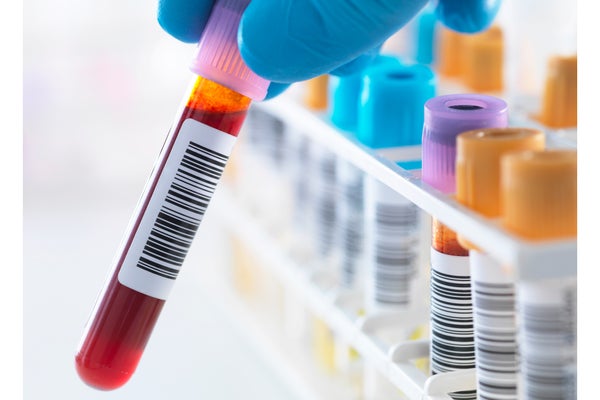
The new findings suggest a simple blood test can accurately predict levels of a protein called amyloid beta in the brain that begins appearing early in the course of the disease before symptoms appear. Amyloid buildup is a key pathological feature of Alzheimer’s, and determining the degree to which someone’s brain is riddled with the molecule is essential for designing effective clinical trials.
At the moment the only way to accurately measure amyloid in a living person is either via costly positron emission tomography imaging (PET scan) or by sampling cerebrospinal fluid (CSF) with a lumbar puncture, or spinal tap. A blood test would offer a cheaper, far less invasive means of determining a patient’s amyloid status. This could encourage more patients to enter clinical trials. It could also help researchers distinguish people with brewing Alzheimer’s from those with other forms of dementia.
On supporting science journalism
If you're enjoying this article, consider supporting our award-winning journalism by subscribing. By purchasing a subscription you are helping to ensure the future of impactful stories about the discoveries and ideas shaping our world today.
Senior study author Katsuhiko Yanagisawa, director general of the National Center for Geriatrics and Gerontology in Japan, is convinced that enough amyloid penetrates the blood–brain barrier to make its way into the bloodstream to be a useful measure of cognitive function. “We think amyloid blood tests could replace costly, invasive amyloid tests, especially when it comes to detecting preclinical Alzheimer’s,” he says. “We hope our biomarker better facilitates clinical trials for [Alzheimer’s] by improving enrollment of participants.”
To measure bits of amyloid coursing through the bloodstream, Yanagisawa and colleagues used a technique called immunoprecipitation with mass spectrometry, which deploysantibodies to bind and identify proteins. The study included 121 people from Japan and 252 from Australia, and both groups involved individuals with normal brain function, mild cognitive impairment and Alzheimer’s. They found the amount of amyloid present in the blood correlated with the degree of cognitive problems. Blood amyloid levels also correlated with findings in the same patients from PET scans and spinal fluid measures.
Yanagisawa believes a simple amyloid blood test would enable recruitment for clinical trials of new drugs in a larger share of the population, as opposed to only those with access to advanced academic centers. Scaling up trial numbers should also help trials more accurately represent the actual population. “This does seem to be an important study,” says James Hendrix, who was not involved in the new research and is director of Global Science Initiatives for the Alzheimer’s Association, the largest nonprofit funder of Alzheimer’s research. “It is from a top research team. It is a decently large sample size. And most important, they are correlating their results to PET and CSF. That cross-validation to other techniques is great to see—we haven’t seen this before for a blood test in Alzheimer’s.”
Emory University neurologist William Hu, who also did not participate in the study, agrees. “The findings are promising as reliable blood biomarkers can lead to early detection with a relatively straightforward procedure and lower costs. Yet he cautions the accuracy of amyloid PET scanning—the standard against which the blood test is being measured—remains controversial, compared with true gold standard of Alzheimer’s, a postmortem inspection of brain tissue.
Hu also points out the overall levels of amyloid differed between the Japanese and Australian groups. “I believe the technology will need further development and standardization to provide more accurate amyloid measures,” he says.
What little encouraging Alzheimer’s treatment data does exist—including that around a promising drug called aducanumab—suggests medications that have gone through clinical trials seem to work better earlier in the dementia disease course, before patients develop full-blown Alzheimer’s. A blood test in at-risk patients would make it an awful lot easier for researchers to identify people at risk for the disease in whom treatment and preventative measures could be more effective.
Yanagisawa and colleagues are now extending and expanding their study in hopes of bringing an amyloid blood test closer to routine clinical use. Multiple authors on the paper have even filed for patents for the technique.
For now, measuring dementia risk with a simple blood drawremains in the realm of research. “It’s good to see this type of study advance, as we desperately need noninvasive and low-cost markers for Alzheimer’s disease,” Hendrix says. “But still, at this point it is not ready for prime time.”