
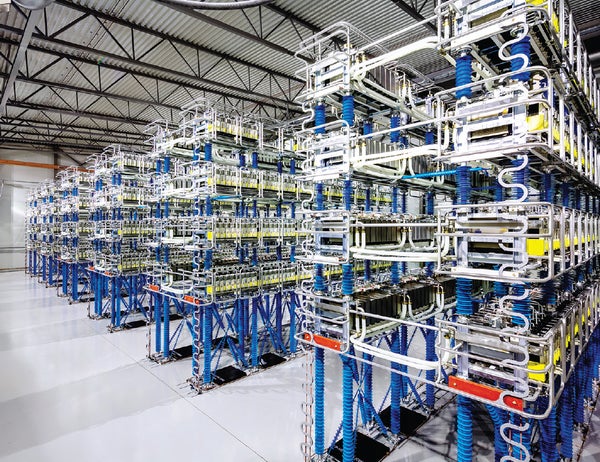
More than 100 years ago scientists and business leaders feuded over the incipient U.S. electrical grid: Should it rely on alternating current (AC) or direct current (DC)? Both are used to transmit electricity—DC flows steadily in one direction, whereas AC varies direction periodically. Thomas Edison championed DC as the better option—and even publicly electrocuted stray animals with AC to convince the public that it posed a danger. By the early 20th century AC prevailed, however, for technical and economic reasons.
Now DC is making a comeback.
In coming years the handful of DC transmission lines scattered across the country today may be joined by at least nine new long-distance, high-voltage DC (HVDC) lines that several companies are planning to build. That is largely a result of one major trend: the Midwest and other regions are now producing a great deal of renewable energy—about 2.8 trillion kilowatt-hours in 2015—and utility companies need a way to deliver it to faraway urban and industrial centers. “You have remote resources, and there's just not enough infrastructure to move that energy to the market,” says Wayne Galli, executive vice president of engineering at Clean Line Energy Partners, which plans to build four HVDC lines. The Houston-based company has already sent out field crews to prepare for construction of one of its lines—it will bring wind energy up to 720 miles from Oklahoma and the Texas panhandle to Tennessee and Arkansas and then on to other nearby states.
On supporting science journalism
If you're enjoying this article, consider supporting our award-winning journalism by subscribing. By purchasing a subscription you are helping to ensure the future of impactful stories about the discoveries and ideas shaping our world today.
Technology for power transmission advanced in the 1970s, allowing direct current to return as a viable option—and for lines more than 300 to 500 miles long, DC outcompetes AC. After a certain distance, AC systems become more costly to build than DC and have larger power losses along the line because of issues such as higher resistance. “Using DC lines is a much better solution for moving power from big, remote wind or solar farms,” says Gregory Reed, director of the University of Pittsburgh's Center for Energy and the Energy GRID Institute. “It's a rapid change in where we're getting our resources from.”
And because renewable energy isn't going away anytime soon, DC likely won't either. But as Galli notes, “DC never totally went away.”