
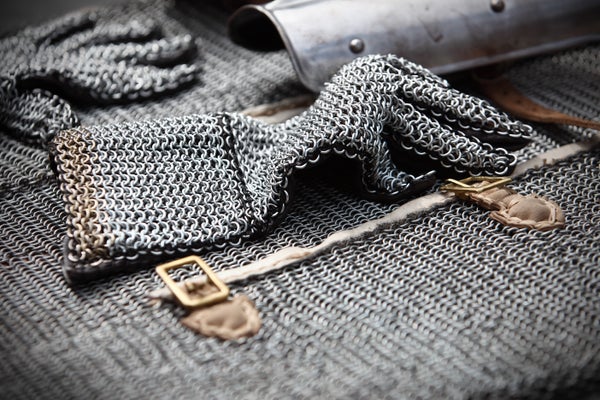
A material inspired by chain mail changes its properties from flexible to hard when it is pressurized. The fabric, developed by Chiara Daraio and her colleagues at the California Institute of Technology, can become more than 25 times as stiff as its original state, the team reports in Nature.
The researchers constructed it from hollow octahedral subunits that interlock but are able to move against one another. Its special properties are based on a process known as “jamming.” When pressure is applied to the material, the octahedral elements become immobile. The fabric behaves as if it had suddenly turned into a solid body. Similarly, chain mail exhibits high-tensile strength to protect a warrior but is able to fit around the body.
Such structured materials—those that can be shaped as required and that can solidify and loosen again on command—are of interest for many technical applications. For example, they could serve as easily transportable construction materials for temporary buildings or bridges.
On supporting science journalism
If you're enjoying this article, consider supporting our award-winning journalism by subscribing. By purchasing a subscription you are helping to ensure the future of impactful stories about the discoveries and ideas shaping our world today.
Daraio and her team built the fabric from three-dimensional “particles” made from struts that form octahedral cages, with each one interlocking with its nearest neighbors. Adjacent octahedrons were rotated 90 degrees from one another and connected at the corners. To put the material under pressure, the researchers packed it in a plastic bag from which the air was pumped out so that the pressure on the structure corresponded to the difference between the external and internal pressures. They then exposed the fabric to pressures between zero and 93 kilopascals to observe its changing properties.
In fact, jamming has a well-known and widely used effect on granular materials and even mayonnaise. It occurs, for example, when you pour rice through a funnel. If you do so too quickly, the grains jam and block the passage. Sand, which hardens under pressure, shows a similar behavior. There is a fundamental difference between grains and chain-mail-like fabrics, however. While grains only show jamming when they are constricted, the fabric made from interlocking components can also solidify under other stresses—when it is bent or stretched, for instance.
Using computer simulations, the group examined how jamming takes place at the level of individual components in the fabric and which factors influence these mechanical properties. In addition, the researchers constructed similar fabrics from differently shaped building blocks. These materials contained the rings of classic chain mail but also octahedrons with different angles or fewer cross struts. The team came across a consistent property in such fabrics: how much they stiffen under stress depends solely on how many contacts the multishaped elements make with one another on average—regardless of the exact structure.
The properties of such chain-mail-like materials may still hold some surprises. Materials researcher Laurent Orgéas of Grenoble Alpes University in France points out in a commentary in Nature that the measurements made by Daraio’s group show indications of nonlinear behavior under stress, which suggests unusual material properties.In addition, the fabric as a whole retains a fairly flat shape. Also worth investigating are chain mail structures fashioned in three dimensions. One idea might consist of an “intelligent” material that changes shape when an electric current or heat is applied.
This article originally appeared in Spektrum der Wissenschaft and was reproduced with permission.