
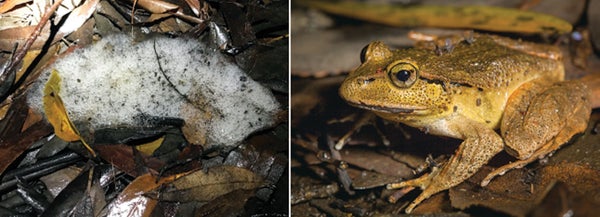
Frothy mucus might not sound like the most inviting living space, but for some frogs' offspring it is a lifesaving refuge from drought. The amphibians often lay their gelatinous eggs in pools of water to provide the moisture needed to develop properly—but those pools can dry up. “The biggest cause of [frog] offspring mortality is desiccation,” says University of Newcastle ecologist John Gould.
When studying frogs in Australia's Watagan Mountains, Gould was surprised to find evaporated puddles where eggs thrived for days, swaddled in nests their mothers whip up by aerating mucus secretions with their toes. “You could see embryos still alive and kicking,” he says.
Scientists had previously hypothesized that several frog and toad species use foam to protect eggs from desiccation, but few studies had tested the idea. So Gould and his colleagues monitored 641 mucus nests built by the sandpaper frog, Lechriodus fletcheri, to determine whether embryos were surviving dry mountain conditions. They also conducted the first laboratory experiments to closely follow eggs' development in nests deprived of water.
On supporting science journalism
If you're enjoying this article, consider supporting our award-winning journalism by subscribing. By purchasing a subscription you are helping to ensure the future of impactful stories about the discoveries and ideas shaping our world today.
The team found that the embryos could indeed successfully develop in a dried-up pool if the eggs encasing them were protected by slimy frog foam. In some nests stranded on dry land, embryos even endured well after full development, until a pool was replenished by rain—and a few successfully hatched into tadpoles. “The froth nest acts almost like a life-support system that sustains the viability of the eggs,” Gould says. He also found that larger nests provided more protection, and eggs closer to the core could survive longer. The new work is detailed in Ichthyology & Herpetology.
Elisa Barreto Pereira, an ecologist at Brazil's Federal University of Goiás who was not involved in the study, says froth nests could be crucial to helping frogs survive as the climate changes. “The foam nest is an important adaptation,” she says—one that evolved several times in different frog groups and continents when Earth's average temperature peaked about 55 million years ago.