
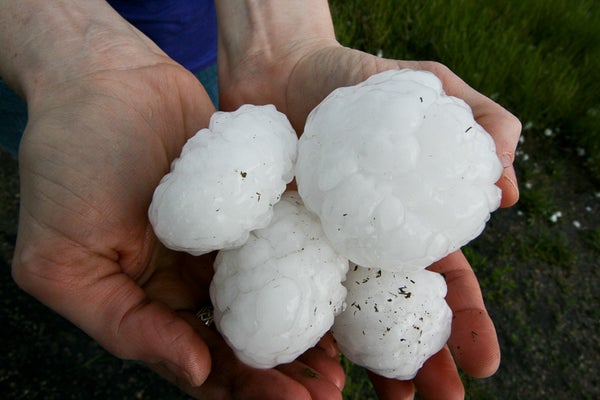
Hail pellets the size of softballs pelted the area near Springfield, Mo., on Tuesday, reportedly damaging cars, homes, and gas meters and even killing a 21-year-old emu at a local zoo.
Hail is basically made up of balls of frozen rain—during thunderstorms, as warm air carries rain droplets high up into the atmosphere, the rain freezes. As more water layers on top of a frozen droplet, it forms a hailstone. Some of the largest hailstones can fall as fast as 72 miles per hour, according to the National Oceanic and Atmospheric Administration.
This week’s hailstorm was “unusual” but “not unheard of” in the region at this time of year, says Alan Gerard, a former NOAA meteorologist and founder of the newsletter Balanced Weather.
On supporting science journalism
If you're enjoying this article, consider supporting our award-winning journalism by subscribing. By purchasing a subscription you are helping to ensure the future of impactful stories about the discoveries and ideas shaping our world today.
It was produced by a “supercell”—a rotating thunderstorm that can produce severe hazards such as tornadoes and large hail, Gerard explains. “When conditions are right, a supercell can ‘split’ into two separate storms, and the left-moving storm has a much higher risk for producing very large hail,” he says. That’s what happened in Springfield.
Across a 100-mile span, the storm dumped hailstones as big as two to 4.75 inches, with the largest landing around the Springfield area, says Mark Burchfield, a meteorologist at the Springfield office of the National Weather Service. The hail caused “significant damage” to vehicles and homes, Burchfield says.
“I’d never seen anything like that in my life,” said local resident Lesa Voss to Springfield’s news channel KY3. “It’s the worst hail I have ever seen.” City Utilities of Springfield, a utility provider, also told KY3 that it had received more than a dozen reports of gas meters hit by hail, which can cause gas leaks.
The killed emu was at Dickerson Park Zoo in Springfield, which also suffered damage in the storm. Another large flightless bird, a rhea, was “under veterinary care,” the zoo said in a social media post. “No guests or staff were injured.”
Damage from hail has increased in in the U.S. in recent years—and there’s some evidence that climate change may be at least partly responsible: A recent study found that warmer temperatures likely helped fuel hailstorms in Europe in May 2025. But more research is needed to understand how climate may be affecting hail across the planet.