
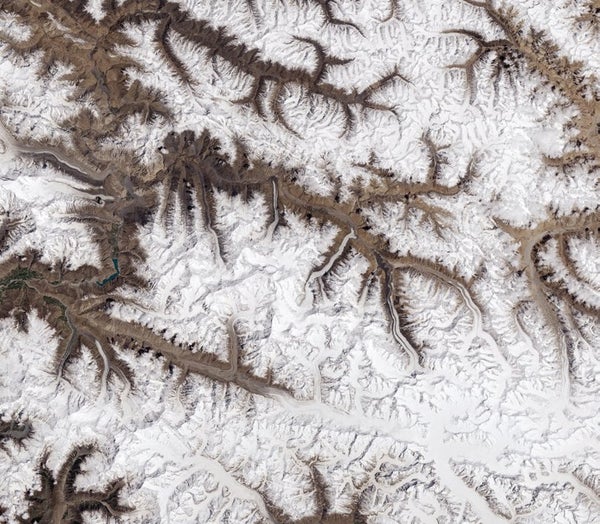
Most glaciers creep along at a pace that is, well, glacial. But one in northern Pakistan breaks into a gallop with astounding speed and regularity: Khurdopin glacier “surges” every two decades, moving roughly 1,500 times its normal pace. This sends ice tumbling into a nearby river, damming it to create a temporary lake that can suddenly inundate nearby villages. Now scientists in Europe have used new high-resolution satellite data to study Khurdopin before and during its most recent surge in 2017, revealing how the event developed on a near daily basis, in unprecedented detail. The observations are critical to monitoring the glacier's hazards and could help to predict when flooding might occur next.
About 1 percent of the world's glaciers exhibit such sudden and large bursts of speed. “It's not 100 percent clear why some glaciers surge and others don't,” says Jakob Steiner, a geoscientist at Utrecht University in the Netherlands, who led the study. Some scientists think water permeates a glacier's base and acts as a lubricant to promote sliding. Sediments between a glacier and the ground may also facilitate slippage.
Steiner and his team analyzed new satellite images of Khurdopin that revealed features as small as three meters across. As snow accumulated on the high-elevation end of the 41-kilometer river of ice, the crushing pressure changed the structure of the water molecules, causing the ice to melt at lower temperatures and allowing the mass to suddenly shift. Khurdopin surged up to 20 meters a day in May 2017, creating a lake that grew to 30 times its size before draining and washing away roads, bridges and farmland, the scientists reported in January in The Cryosphere.
On supporting science journalism
If you're enjoying this article, consider supporting our award-winning journalism by subscribing. By purchasing a subscription you are helping to ensure the future of impactful stories about the discoveries and ideas shaping our world today.
“This work has characterized the surge in exceptional detail,” says Duncan Quincey, a glaciologist at the University of Leeds in England, who was not involved in the study. Steiner and his colleagues plan to return to Pakistan this year to continue installing temperature and rain sensors around Khurdopin and training area residents to monitor the glacier and its transient lake.