
Choked: Life and Breath in the Age of Air Pollution
by Beth Gardiner.
University of Chicago Press, 2019 ($27.50)
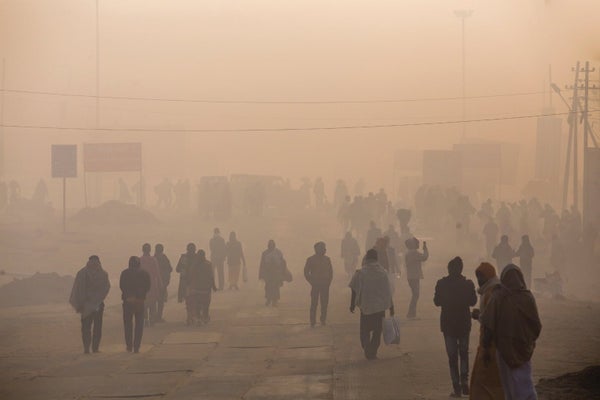
Breath is life. But pollution-laden air is “quietly poisoning us,” Gardiner writes in her arresting account of one of the biggest environmental threats to human health, one that claims seven million premature deaths a year worldwide. Through a world tour of air-pollution hotspots, Gardiner, a journalist, personalizes the damage pollutants do with vivid portraits of residents living alongside dirty ports in Los Angeles, women inhaling acrid smoke from cooking fires in rural India and the “sour taste” left in her mouth by London's diesel-clogged air. She lays out solutions, such as the landmark Clean Air Act and China's concerted move away from coal, although she is clear-eyed about potential hurdles and the recent push to undo critical safeguards. “This is not an insoluble puzzle. . . . We know how to fix it,” Gardiner says. The question is, Will we? —Andrea Thompson
Mendeleyev’s Dream: The Quest for the Elements
by Paul Strathern.
Pegasus Books, 2019 ($27.95)
On supporting science journalism
If you're enjoying this article, consider supporting our award-winning journalism by subscribing. By purchasing a subscription you are helping to ensure the future of impactful stories about the discoveries and ideas shaping our world today.
The structure of the periodic table of elements came to Dmitri Mendeleyev in a dream. The Russian scientist had been struggling for three nights and three days to find a pattern organizing the 63 known chemical elements, when he finally fell into a frustrated doze at his desk. When he awoke, he wrote down what had come to him while sleeping: a table listing the elements according to both their atomic weight and their chemical properties, which repeated at periodic intervals. Writer Strathern tells the story of this monumental discovery, as well as the history of chemistry leading to this point, to show how science has progressed from believing the world was made of the elements earth, air, fire and water to our present-day knowledge of 118 elements and counting. —Clara Moskowitz
Range: Why Generalists Triumph in a Specialized World
by David Epstein.
Riverhead Books, 2019 ($28)
How does someone become the world's greatest chess player, violinist, chemist or pro golfer? Conventional wisdom holds that focusing on one endeavor early in life and pouring thousands of practice hours into it is the only way to excel. Sports journalist Epstein challenges that assumption in a book that studies artists, athletes, scientists and musicians who did not follow a fixed path to success. One surprising example is eight-time Wimbledon champion Roger Federer, who bounced around several sports before settling on tennis. Generalists, Epstein finds, often find their direction later and dabble in many areas rather than homing in on any given pursuit. He argues that approaching a field with an outsider's unfamiliarity may lead to brilliant breakthroughs. —Jim Daley
Crisis in the Red Zone: The Story of the Deadliest Ebola Outbreak in History, and of the Outbreaks to Come
by Richard Preston.
Random House, 2019 ($28)
In 1976, from somewhere in the rain forest in what is now the Democratic Republic of the Congo, an unknown virus jumped from an animal into a human. That strain of virus quickly spread and infected hundreds of people and then vanished for decades. Writer Preston weaves this thrilling tale of the reemergence of the Ebola virus in 2013, told in the words of those in the thick of the health crisis. It reads like fiction: In one ward in Sierra Leone during the latest outbreak, disease researcher Lina Moses ran in flip-flops among the hospital wings, helping with one emergency after another. At night, shaky and feverish with malaria, she would lie on her bed and cry, looking at the photos of her daughters in the locket around her neck. She lived.