
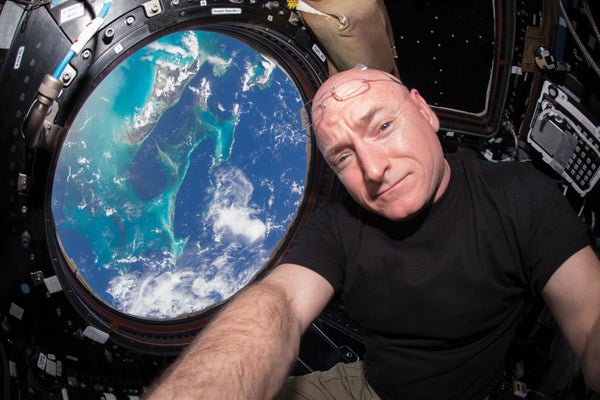
Scott Kelly is the first American to spend almost a year in space. The NASA astronaut lived for a record 340 days onboard the International Space Station (ISS) from 2015 to 2016. Like other astronauts, he endured the stresses of microgravity, cosmic radiation and “headward fluid shift,” in which blood and tissue fluid collect in the head. But Kelly’s experience was unique in that researchers painstakingly documented his physiology and cognitive performance while in orbit—and simultaneously monitored his identical twin brother, Mark Kelly, as an earthbound control.
The NASA Twins Study, a groundbreaking analysis of the effects of life in space, was published in April in Science. It revealed that Kelly underwent changes (which his twin did not experience) in his eyes, carotid artery, DNA expression and cognitive performance during the mission. Most measurements returned to preflight levels after he returned to Earth—although some of his cognitive scores worsened. Scientific American spoke with Kelly about the study, the difficulties of prolonged spaceflight and the implications for future long-term missions. An edited excerpt follows.
What were the biggest physiological challenges you faced in orbit?
On supporting science journalism
If you're enjoying this article, consider supporting our award-winning journalism by subscribing. By purchasing a subscription you are helping to ensure the future of impactful stories about the discoveries and ideas shaping our world today.
That headward fluid shift is the worst in the beginning. Your body adjusts to it over time, but it never adjusts completely. I always felt pressure in my head. Another thing that varied from high to too high was the carbon dioxide. When it was at its lowest, it was 10 times what it would be on Earth. When it was at its highest, it was about 30 times what it is on Earth. It would burn your eyes. I was able to tell what the CO2 level was pretty accurately without having to look at the measurement.
EDITORS’ NOTE: According to a 2012 NASA study, the ISS functions at higher than normal concentrations of CO2 “out of operational necessity,” but research supports these levels as safe.
What physical changes did you experience back on Earth?
In the absence of gravity, not only is your heart less fit, but your veins and arteries are also not as strong. And once you get back to Earth, all the blood just wants to pool in your legs. That lasted for weeks. I would stand up, and my legs would swell up like water balloons. I had rashes and hives on my skin whenever it had any pressure on it: on my butt, the back of my legs, my elbows. That was surprising. I was sore. I was tired for a long time. From a mental state, your schedule is so tightly controlled onboard the ISS—then, when you get back, you don’t have anyone telling you what to do anymore. You feel a little lost for a bit. When you don’t have that structure, it’s kind of hard to be motivated at first.
Why might your cognitive test scores have declined once you were back on Earth?
When you’re up there, and you’re doing tests a lot, just like anything else you get better at them. But when I got back, I wasn’t feeling great. Imagine showing up to your SAT with the flu: you probably wouldn’t do too well. I attribute a lot of my performance on those tests not necessarily to my cognitive ability but more to the other symptoms I had. Even though you might not have a cognitive deficit, the fact that you feel like crap makes it very hard to do those tests.
EDITORS’ NOTE: The NASA Twins Study researchers suggested that several factors, including Kelly’s hectic postflight schedule, may have contributed to the apparent decline in performance.
What does your experience tell us about longer astronaut missions in the future?
The researchers didn’t observe anything that would prevent us from going to Mars. Certainly the radiation is something we’ve got to deal with, although this wasn’t really an experiment on that. But if we’re going to go beyond Mars, we are going to have to start thinking about artificial gravity. I flew in space for seven, 13, 154 and then 340 days. The longer you’re there, the more symptomatic you are when you return. I couldn’t imagine coming back to Earth after being in space for many years.