
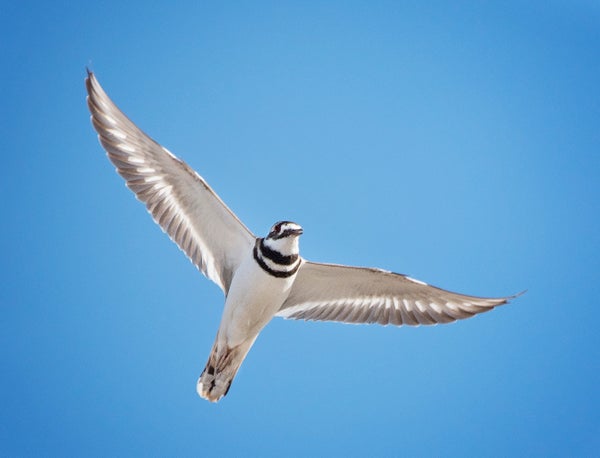
The Great Basin, one of North America’s most important habitats for migratory birds, is getting warmer, drier and saltier—and that’s a problem for some of the species that call it home. Killdeer, snipes, terns and grebes are among those already harmed, and scientists are concerned that more species might be hurt.
The Great Basin is the continent’s largest continuous network of wetlands. It spans from Oregon, crosses Nevada and into Utah, and it touches parts of California, Idaho and Wyoming. It’s a critical stopover along a major migratory bird route down the West Coast of North and South America called the Pacific Flyway. Millions of waterbirds rest or breed in the Great Basin each year.
Research released Friday in the journal Scientific Reports paints an alarming portrait of the region’s future. It finds that waterbird populations are already changing in the Great Basin because of climate change. As local hydrology continues to shift, more and more species may be at risk of declines, experts say.
On supporting science journalism
If you're enjoying this article, consider supporting our award-winning journalism by subscribing. By purchasing a subscription you are helping to ensure the future of impactful stories about the discoveries and ideas shaping our world today.
The study, which examines a century of regional water and climate trends, finds that climatic changes have been particularly intense over the last few decades. Between 1980 and 2008, the rate of warming doubled to nearly half a degree per decade, with the greatest warming occurring during the summer months. The region has also become drier since 1980.
In keeping with the warming trend, there’s also been a recent shift toward more rain, rather than snow, in the winter, the research suggests. Generally, melting snow flowing down from the mountains helps to supply fresh water in many of the Western states during the spring and summer. But with declines in seasonal snowpack, the flow is happening sooner in the season, and overall water availability is declining.
At the same time, bird populations in the Great Basin are changing over time—and the new analysis suggests these changes are linked to recent trends in temperature and hydrology. For instance, the study found that at least five species have experienced recent population declines associated with rising temperatures. These include the killdeer, Wilson’s snipe, black tern, Western grebe and Clark’s grebe.
That’s not to say every species that passes through the Great Basin is suffering. The study found that a few species, such as the sandhill crane and the long-billed curlew, seem to have responded positively to recent climatic changes.
But scientists worry that more species may decline if the trends continue. The researchers suggest that “while we present waterbird species responding negatively as well as positively to a warmer, drier Great Basin, ultimately all species will continue to be stressed by an uninterrupted climate shifts [sic].”
One concern about the changing hydrology in the Great Basin is that total water availability isn’t just declining as freshwater inputs slow down. The lakes are also getting saltier. The Great Basin includes a network of both freshwater wetlands and saltwater lakes. Some adult migratory waterbirds can metabolize salt water, but their young chicks can’t, meaning freshwater resources are crucial during the breeding season. And even for adult waterbirds, an increasingly salty ecosystem can be a problem. It can lead to declines in fish, insects and other small animals that birds feed on.
The new research isn’t the first to identify this problem. Case studies on individual lakes throughout the Great Basin have also pointed to waterbird declines linked to the changing climate. Studies have shown that Oregon’s Lake Abert, for instance, is shrinking and growing saltier. And it’s seen significant declines in some of its residents in the last few years, including phalaropes and grebes.
The researchers note that bird declines in the Great Basin may signal trouble for their populations at large. While the area is a stopover on a much longer journey for some birds, other species tend to stay there, or nearby, year-round—meaning as the habitat degrades, it’s “not clear where the displaced species are finding suitable habitat.”
For birds with longer migrations, skipping the Great Basin may not be an option. The next comparable site along the Pacific Flyway is hundreds of miles away.
Conservation groups are aware of the issue. A 2017 report from the National Audubon Society on water and waterbirds in the West also noted that declining water levels and increasing salinity are a growing threat to waterbird populations.
“Saline lakes are vital to sustaining migrating and breeding waterbirds, shorebirds, and waterfowl up and down the Central and Pacific Flyways,” the report warns. “These habitats and concentrated food resources are irreplaceable: no other ecosystem in the Intermountain West can meet these birds’ unique requirements.”
Reprinted from Climatewire with permission from E&E News. E&E provides daily coverage of essential energy and environmental news at www.eenews.net.