A Necessary Evil

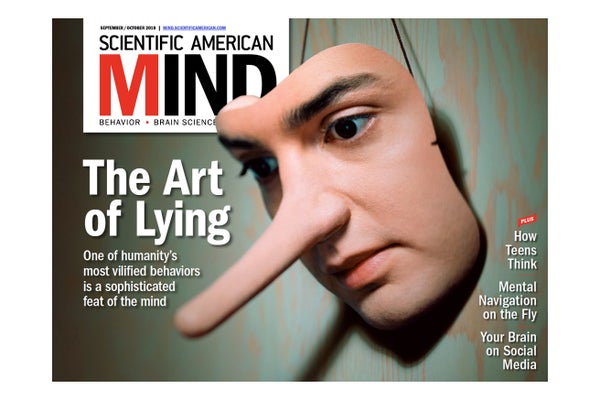
Scientific American Mind, September/October 2018 cover.

Hugh Kretschmer

Join Our Community of Science Lovers!


On supporting science journalism

If you're enjoying this article, consider supporting our award-winning journalism by subscribing. By purchasing a subscription you are helping to ensure the future of impactful stories about the discoveries and ideas shaping our world today.


On November 17, 1973, President Richard M. Nixon infamously declared on television “I am not a crook” when questioned about his role in what would later be called the Watergate scandal. Diligent work by investigative reporters soon after revealed the falsity in his words. In this issue’s cover feature, Theodor Schaarschmidt tells the story of another politician—a high-ranking policy official in Europe—who came down with a strange problem: on some occasions of telling a lie, he would pass out and convulse on the floor, truly perplexing his neurologist. However impossible (or fantastical), I have never more wished that cases of Pinocchio nose would break out among our politicians. But, alas, telltale signs of lying would likely trigger the breakdown of society. Imagine disclosing to each person you interact with today the real thoughts in your head. Yes, that would become messy quickly. Lying seems to be a requirement of society, but it is also an art form, one that takes effort and special brain functionality (read more in “The Art of Lying”).

Elsewhere in this issue Kerri Smith details the fascinating research on how adolescents embrace risk-taking—good news, parents: that same rebellious behavior can have many positive effects (see “Sex, Drugs and Self-Control”). And in “Bat Man,” Alison Abbott describes the work of neuroscientist Nachum Ulanovsky, who has constructed a “flight tunnel” to study the navigating brains of bats in real time. Enjoy and let us know what you think!

Andrea Gawrylewski is chief newsletter editor at Scientific American. She writes the daily Today in Science newsletter and oversees all other newsletters at the magazine. In addition, she manages all special editions and in the past was the editor for Scientific American Mind, Scientific American Space & Physics and Scientific American Health & Medicine. Gawrylewski got her start in journalism at the Scientist magazine, where she was a features writer and editor for "hot" research papers in the life sciences. She spent more than six years in educational publishing, editing books for higher education in biology, environmental science and nutrition. She holds a master's degree in earth science and a master's degree in journalism, both from Columbia University, home of the Pulitzer Prize.

More by Andrea Gawrylewski
SA Mind Vol 29 Issue 5This article was published with the title “A Necessary Evil” in SA Mind Vol. 29 No. 5 (), p. 2
doi:10.1038/scientificamericanmind0918-2

It’s Time to Stand Up for Science

If you enjoyed this article, I’d like to ask for your support. Scientific American has served as an advocate for science and industry for 180 years, and right now may be the most critical moment in that two-century history.

I’ve been a Scientific American subscriber since I was 12 years old, and it helped shape the way I look at the world. SciAm always educates and delights me, and inspires a sense of awe for our vast, beautiful universe. I hope it does that for you, too.

If you subscribe to Scientific American, you help ensure that our coverage is centered on meaningful research and discovery; that we have the resources to report on the decisions that threaten labs across the U.S.; and that we support both budding and working scientists at a time when the value of science itself too often goes unrecognized.

In return, you get essential news, captivating podcasts, brilliant infographics, can't-miss newsletters, must-watch videos, challenging games, and the science world's best writing and reporting. You can even gift someone a subscription.

There has never been a more important time for us to stand up and show why science matters. I hope you’ll support us in that mission.

Thank you,

David M. Ewalt, Editor in Chief, Scientific American

Subscribe