
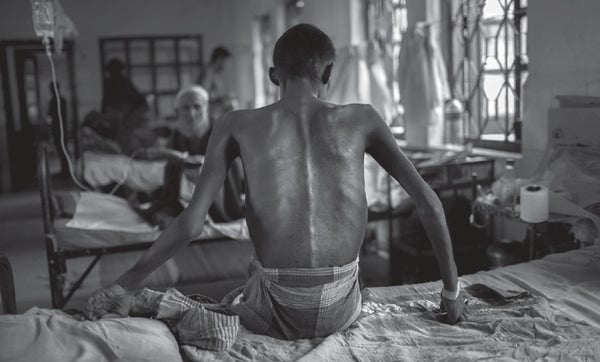
As much as one third of the global population is currently infected with the bacterium that causes tuberculosis (TB), a disease typically concentrated in the lungs and characterized by weakness, fever, coughing and chest pain. About 9.6 million new infections occurred in 2014, the most recent year for which numbers are available. Roughly 1.5 million people died of TB that same year. The ability to easily, inexpensively and accurately diagnose TB is of utmost importance, but the most commonly used method fails, at least to some extent, on all three counts. A new blood-based technique might considerably rein in this epidemic.
The conventional TB test scans for bacterial DNA in coughed-up mucus, or sputum. But some children struggle to produce a sample on request. The test also can miss TB in people simultaneously infected with HIV because the telltale bacteria may exist in numbers too low to detect or outside the lungs. In addition, the test costs up to $10, a prohibitive fee in many developing countries. As a result of these constraints, a large percentage of TB cases are diagnosed late or not at all, leaving serious infections untreated and more liable to spread.
Two years ago the World Health Organization put out a call for an improved TB diagnostic. In response, Purvesh Khatri, a Stanford University medical professor, and his colleagues combed through the human genome and found three genes that distinguish active TB from other diseases. The team then developed a way to detect these genes in blood.
On supporting science journalism
If you're enjoying this article, consider supporting our award-winning journalism by subscribing. By purchasing a subscription you are helping to ensure the future of impactful stories about the discoveries and ideas shaping our world today.
According to their study, published in the Lancet Respiratory Medicine, the test is equally sensitive among patients with and without HIV coinfection and correctly detected TB in 86 percent of pediatric cases. Additional points in favor of a blood assay include that it can be performed at a clinic and yield same-day results, unlike the case for a sputum test. That is especially advantageous in the developing world, where showing up for even a single appointment presents a tremendous burden. “You want to be able to initiate treatment immediately,” says Sheela Shenoi, a Yale University professor of medicine focused on AIDS.
The technology has not been used in the diagnosis of new patients and may be difficult to scale up, but in the meantime, Khatri has filed a patent for the test. He thinks it could cost less than half as much as the current one. “If this three-gene signature could be developed into a point-of-care test,” Shinoi says, “it would revolutionize TB diagnostics.”