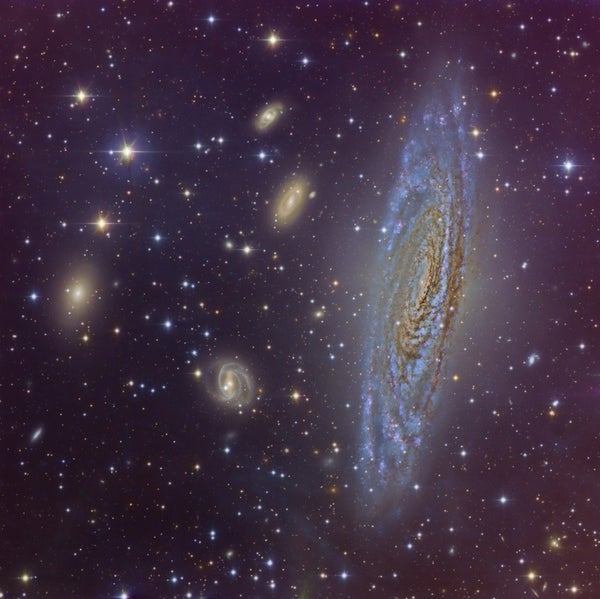
The spiral galaxy NGC 7331 [ right ] has sometimes been referred to as a twin of the Milky Way due to its similar size and shape.
Vicent Peris (OAUV)/Gilles Bergond/CAHA
Join Our Community of Science Lovers!
On supporting science journalism
If you're enjoying this article, consider supporting our award-winning journalism by subscribing. By purchasing a subscription you are helping to ensure the future of impactful stories about the discoveries and ideas shaping our world today.
The spiral galaxy NGC 7331 [right] has sometimes been referred to as a twin of the Milky Way due to its similar size and shape. Discovered by English astronomer Sir William Herschel in 1784, the galaxy lies some 50 million light-years away in the Pegasus constellation. (The galaxies in the center of the image appear smaller because they are much farther away.) This crisp new color-filtered image from Calar Alto Astronomical Observatory in southern Spain was made by pointing that observatory’s largest telescope, with an aperture of 3.5 meters, at NGC 7331 for more than two hours over multiple exposures. The galaxy's angle as viewed from Earth allows astronomers to peer along its disk and gives images such as this one their rich sense of depth.
It’s Time to Stand Up for Science
If you enjoyed this article, I’d like to ask for your support. Scientific American has served as an advocate for science and industry for 180 years, and right now may be the most critical moment in that two-century history.
SciAm always educates and delights me, and inspires a sense of awe for our vast, beautiful universe. I hope it does that for you, too.
If you subscribe to Scientific American, you help ensure that our coverage is centered on meaningful research and discovery; that we have the resources to report on the decisions that threaten labs across the U.S.; and that we support both budding and working scientists at a time when the value of science itself too often goes unrecognized.