
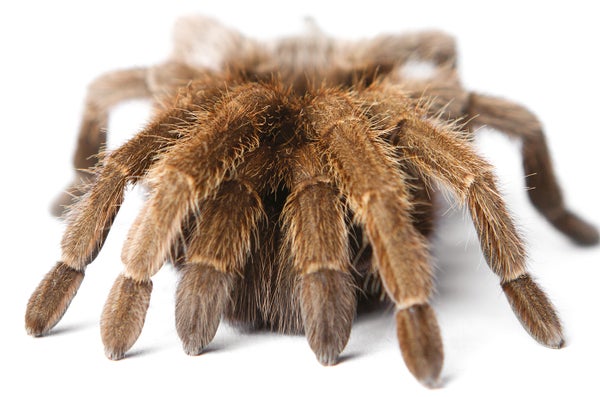
The sight of a spider casts dread into some people's hearts. This fear, known as arachnophobia, is perturbing, irrational and debilitating. But at its essence, fear is rooted in memory, and memory is plastic.
For years the mainstay treatment for phobias has been exposure therapy—gradually familiarizing a patient with the source of his or her fear by repeatedly presenting it in a safe environment. A related approach aims to disrupt the fear memory itself. In a study published in August 2016 in Current Biology, a team of researchers in Sweden successfully did just that with chronic arachnophobia sufferers.
The researchers showed 45 arachnophobes photographs of spiders for several seconds to trigger their fear. Half the participants were shown images of these arthropods again 10 minutes later; the other half saw them again after six hours. Functional MRI revealed increased activity in the basolateral amygdala—a brain region that responds to scary stimuli—when subjects in both groups were looking at the creepy crawlers. On seeing the pictures again, however, the 10-minute-interval group had lower amygdala activity than the six-hour group and avoided spider images less in behavioral tests days later.
On supporting science journalism
If you're enjoying this article, consider supporting our award-winning journalism by subscribing. By purchasing a subscription you are helping to ensure the future of impactful stories about the discoveries and ideas shaping our world today.
The key to this difference may lie in how memory works. When subjects first see the photos and are reminded of their fear, the memory “destabilizes, and it has to be resaved,” says Johannes Björkstrand, a psychologist at Uppsala University who led the study. Subjects in the 10-minute-interval group did not have enough time to resave their fear memory, he says, before being shown more spider pictures, whereas the other subjects had plenty of time and retained their original fear.
Memory-disruption therapy might one day be used in the clinic. For example, patients would be reminded of their fear for one minute and, 10 minutes later, would receive three hours of exposure. This could be repeated over several sessions, as with traditional exposure therapy. Larger, longer-term trials are needed to determine if the method works better than standard exposure therapy. If successful, the researchers say the treatment could be investigated for other phobias, as well as post-traumatic stress disorder and related anxiety disorders.