
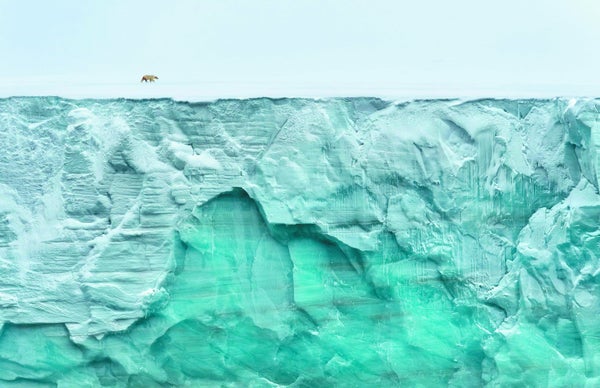
Our Planet
by Alastair Fothergill and Keith Scholey with Fred Pearce.
Ten Speed Press, 2019 ($35)
This month the new nature documentary series Our Planet will be released on Netflix, from the same team that created Planet Earth and The Blue Planet. The companion book by co-producers Fothergill and Scholey can certainly stand on its own, with many images leaving the viewer wondering, “How'd they get that shot?”: A lone polar bear treks along the ridge of a jagged, blue and glistening ice cap in the Russian High Arctic (above). An iridescent turquoise European kingfisher seems frozen in time as it dives for minnows off its mossy perch. A brown bear peeks around the tree in a Slovenian forest—its expression so humanlike, you could dare call it shy. This collection goes beyond photography, though, with a thorough discussion of the conservation challenges facing many ecosystems on Earth. It's not enough to merely look at the planet around us—we must understand how humans impact it.
Eating the Sun: Small Musings on a Vast Universe
by Ella Frances Sanders.
Penguin Books, 2019 ($17)
On supporting science journalism
If you're enjoying this article, consider supporting our award-winning journalism by subscribing. By purchasing a subscription you are helping to ensure the future of impactful stories about the discoveries and ideas shaping our world today.
From the atoms that make up our bodies to the galactic supercluster that houses the Milky Way, writer and illustrator Sanders elucidates many of the wonders of our world through drawings and conversational explanations. While describing lunar theory, for example, she compares the moon and Earth's locked synchronous rotation to the movement of dance partners: “How glad we can be, that we have someone to figure out this universe business alongside, to dance with, to gradually lengthen our days and keep us slow.” A star's death, trees helping one another survive and the ways our brain rewrites memories are also among the concepts Sanders demystifies. Each inspiring snapshot feeds the curiosity of anyone interested in exploring the universe that we exist in and that exists in us. —Sunya Bhutta
Einstein’s Unfinished Revolution: The Search for What Lies beyond the Quantum
by Lee Smolin.
Penguin Press, 2019 ($28)
Quantum mechanics—the basis for our understanding of particles and forces—is arguably the most successful theory in all of science. But its success has come at a price: unresolved mysteries at the theory's heart, such as the paradoxical wave-particle duality of quantum objects, can make modern physics seem decidedly metaphysical. Simply put, if mainstream interpretations of quantum mechanics are true, then the central, most cherished tenet of physics—that an objective reality exists independently of our mind but is still comprehensible—must be false. Smolin, a member of the Perimeter Institute for Theoretical Physics in Ontario, argues against this vexing status quo: “It is possible to be a realist while living in the quantum universe.” —Lee Billings
Frankie: How One Woman Prevented a Pharmaceutical Disaster
by James Essinger and Sandra Koutzenko.
Wellspring, 2019 ($24.95)
On March 8, 1962, pharmacologist Frances (“Frankie”) O. Kelsey, a medical reviewer at the FDA, received a most unexpected letter. The drug firm that had pressured her to approve the distribution of a sleeping pill was withdrawing its request. For nearly two years she had refused to accede—there was not enough evidence to prove the medication was safe. As it turned out, the drug, thalidomide, which was also used to treat morning sickness in pregnancy, had been linked to birth defects in Europe and elsewhere. In the end, it never pervaded the U.S. market. Writers Essinger and Koutzenko unearth the story of Kelsey, who helped prevent a public health tragedy by standing her ground in the name of scientific proof. —Emiliano Rodríguez Mega
