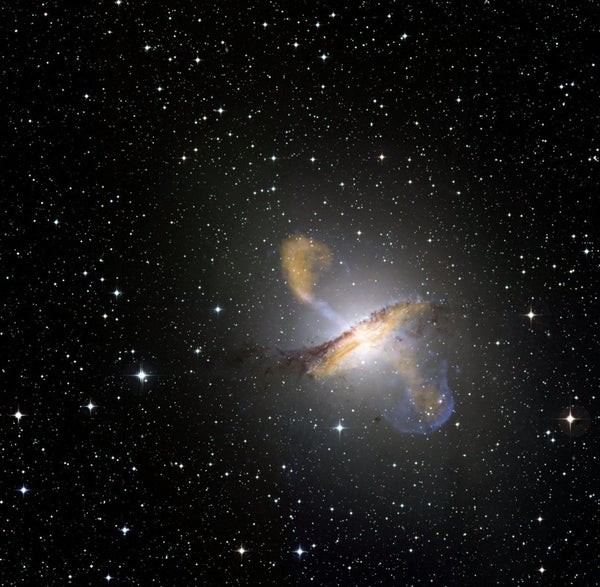
This false-color composite image shows the nearby galaxy Centaurus A, also known as NGC 5128, whose unusual shape is thought to result from the merger of a spiral and an elliptical galaxy.
ESO/WFI (optical); MPIfR/ESO/APEX/A. Weiss et al. (submillimeter); NASA/CXC/CfA/R. Kraft et al. (x-ray)
Join Our Community of Science Lovers!
On supporting science journalism
If you're enjoying this article, consider supporting our award-winning journalism by subscribing. By purchasing a subscription you are helping to ensure the future of impactful stories about the discoveries and ideas shaping our world today.
This false-color composite image shows the nearby galaxy Centaurus A, also known as NGC 5128, whose unusual shape is thought to result from the merger of a spiral and an elliptical galaxy. The vast detail of the picture is made possible by merging data from three telescopes operating in three wavelengths: one in the x-ray, one in the optical and one in the relatively long-wavelength submillimeter realm. The radio jets emanating from the galaxy's center mark the location of a suspected supermassive black hole.
It’s Time to Stand Up for Science
If you enjoyed this article, I’d like to ask for your support. Scientific American has served as an advocate for science and industry for 180 years, and right now may be the most critical moment in that two-century history.
SciAm always educates and delights me, and inspires a sense of awe for our vast, beautiful universe. I hope it does that for you, too.
If you subscribe to Scientific American, you help ensure that our coverage is centered on meaningful research and discovery; that we have the resources to report on the decisions that threaten labs across the U.S.; and that we support both budding and working scientists at a time when the value of science itself too often goes unrecognized.