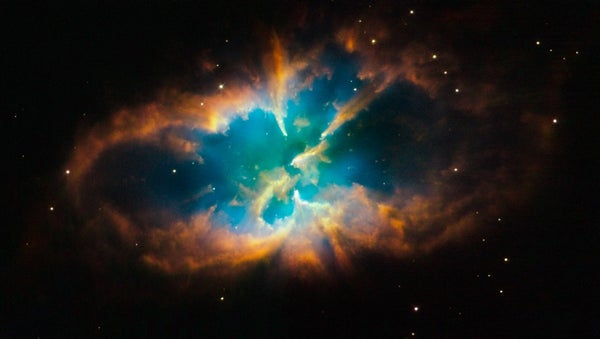
This November photograph from the Hubble Space Telescope shows the planetary nebula NGC 2818 in its parent star cluster.
NASA, ESA, and the Hubble Heritage Team (STScI/AURA)
Join Our Community of Science Lovers!
On supporting science journalism
If you're enjoying this article, consider supporting our award-winning journalism by subscribing. By purchasing a subscription you are helping to ensure the future of impactful stories about the discoveries and ideas shaping our world today.
This November photograph from the Hubble Space Telescope shows the planetary nebula NGC 2818 in its parent star cluster. Both the nebula, a luminous cloud of matter ejected from a dying star, and the cluster are about 10,000 light-years away in the constellation Pyxis. Such a loosely bound star cluster would usually disband before one of its stars threw off a nebula, making NGC 2818 a relatively rare sight. This composite, false-color image, requiring two hours of exposure time on Hubble's Wide Field Planetary Camera 2, was made by assigning colors to different emission wavelengths: red for nitrogen, green for hydrogen and blue for oxygen.
It’s Time to Stand Up for Science
If you enjoyed this article, I’d like to ask for your support. Scientific American has served as an advocate for science and industry for 180 years, and right now may be the most critical moment in that two-century history.
SciAm always educates and delights me, and inspires a sense of awe for our vast, beautiful universe. I hope it does that for you, too.
If you subscribe to Scientific American, you help ensure that our coverage is centered on meaningful research and discovery; that we have the resources to report on the decisions that threaten labs across the U.S.; and that we support both budding and working scientists at a time when the value of science itself too often goes unrecognized.