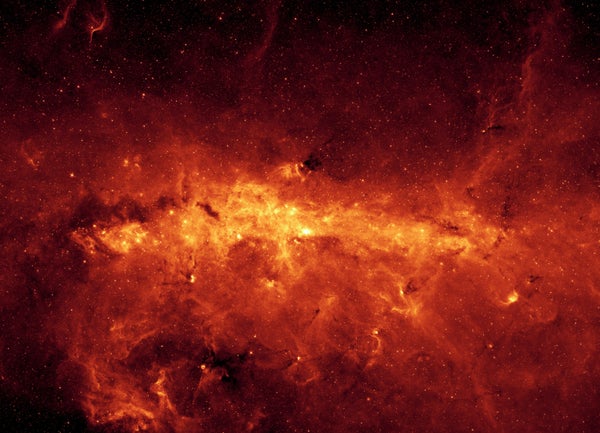
A Rage to Master the Universe

NASA and JPL-Caltech
 

Join Our Community of Science Lovers!


On supporting science journalism

If you're enjoying this article, consider supporting our award-winning journalism by subscribing. By purchasing a subscription you are helping to ensure the future of impactful stories about the discoveries and ideas shaping our world today.


In March of this year, the world mourned the passing of legendary physicist and cosmologist Stephen Hawking. His vast contributions to the field don’t need to be rehashed here, but his work advanced the understanding of the origins of the universe, the nature of black holes and the very makeup of the cosmos. Though severely physically disabled at the end of his life from ALS, Hawking and his collaborators Thomas Hertog and James Hartle were still knee-deep in developing an alternative theory of the universe—that the universe is approximately uniform on the largest scales. Alexander Hellemans sat down with Hertog to discuss this latest work [see “A Conversation with Thomas Hertog: One of Stephen Hawking’s Final Collaborators”].

What strikes me about Hawking, and the many other researchers in the field, is the relentless drive to keep going, especially in one of the most mysterious, and sometimes, mindboggling areas of inquiry. It’s the kind of obsessive “rage to master” that psychologists observe in savant child artists.

Elsewhere in this issue, Lee Billings covers the growing debate among physicists who are trying to reconcile two data sets that tell divergent stories about how fast our universe is expanding [see “Cosmic Conflict”]. The biggest discoveries in physics are still ahead of us, and their pursuers keep raging on.

Andrea Gawrylewski is chief newsletter editor at Scientific American. She writes the daily Today in Science newsletter and oversees all other newsletters at the magazine. In addition, she manages all special editions and in the past was the editor for Scientific American Mind, Scientific American Space & Physics and Scientific American Health & Medicine. Gawrylewski got her start in journalism at the Scientist magazine, where she was a features writer and editor for "hot" research papers in the life sciences. She spent more than six years in educational publishing, editing books for higher education in biology, environmental science and nutrition. She holds a master's degree in earth science and a master's degree in journalism, both from Columbia University, home of the Pulitzer Prize.

More by Andrea Gawrylewski
SA Space & Physics Vol 1 Issue 3This article was published with the title “A Rage to Master the Universe” in SA Space & Physics Vol. 1 No. 3 ()
doi:10.1038/scientificamerican082018-15UmUqkJrviPUWClDpJCRZ

It’s Time to Stand Up for Science

If you enjoyed this article, I’d like to ask for your support. Scientific American has served as an advocate for science and industry for 180 years, and right now may be the most critical moment in that two-century history.

I’ve been a Scientific American subscriber since I was 12 years old, and it helped shape the way I look at the world. SciAm always educates and delights me, and inspires a sense of awe for our vast, beautiful universe. I hope it does that for you, too.

If you subscribe to Scientific American, you help ensure that our coverage is centered on meaningful research and discovery; that we have the resources to report on the decisions that threaten labs across the U.S.; and that we support both budding and working scientists at a time when the value of science itself too often goes unrecognized.

In return, you get essential news, captivating podcasts, brilliant infographics, can't-miss newsletters, must-watch videos, challenging games, and the science world's best writing and reporting. You can even gift someone a subscription.

There has never been a more important time for us to stand up and show why science matters. I hope you’ll support us in that mission.

Thank you,

David M. Ewalt, Editor in Chief, Scientific American

Subscribe