
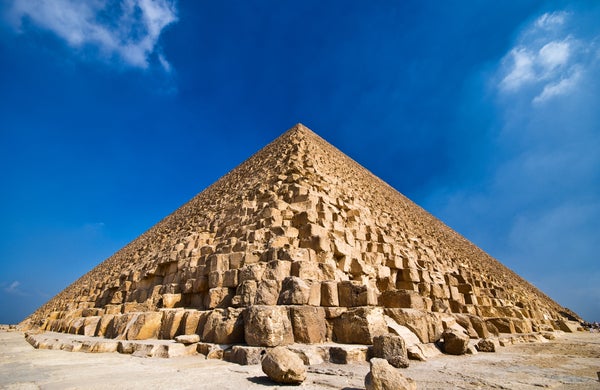
Archaeologists have long wondered exactly how the ancient Egyptians constructed the world’s biggest pyramid, the Great Pyramid. Now, they may have discovered the system used to haul massive stone blocks into place some 4,500 years ago.
They discovered the remains of this system at the site of Hatnub, an ancient quarry in the Eastern Desert of Egypt. The contraption would have been used to transport heavy alabaster stones up a steep ramp, according to the archaeologists working at the site, from the Institut français d’archéologie orientale (French Institute for Oriental Archaeology)in Cairo and from the University of Liverpool in England. And it was possibly how Egyptians built the Great Pyramid, in the name of the pharaoh Khufu. [In Photos: Inside Egypt’s Great Pyramids]
“This system is composed of a central ramp flanked by two staircases with numerous post holes,” Yannis Gourdon, co-director of the joint mission at Hatnub, told Live Science. “Using a sled which carried a stone block and was attached with ropes to these wooden posts, ancient Egyptians were able to pull up the alabaster blocks out of the quarry on very steep slopes of 20 percent or more.”
On supporting science journalism
If you're enjoying this article, consider supporting our award-winning journalism by subscribing. By purchasing a subscription you are helping to ensure the future of impactful stories about the discoveries and ideas shaping our world today.
The ropes attached to the sled acted as a “force multiplier,” making it easier to pull the sled up the ramp, said Roland Enmarch, the other co-director of the Hatnub mission.
“This kind of system has never been discovered anywhere else,” Gourdon said. “The study of the tool marks and the presence of two [of] Khufu’s inscriptions led us to the conclusion that this system dates back at least to Khufu’s reign, the builder of the Great Pyramid in Giza,” he added.
“As this system dates back at least to Khufu’s reign, that means that during the time of Khufu, ancient Egyptians knew how to move huge blocks of stone using very steep slopes. Therefore, they could have used it for the construction [of] his pyramid,” Gourdon said.
The Great Pyramid is the largest of the three Giza Pyramids, built for each of three pharaohs —Khufu, Khafre and Menkaure. Khufu’s is the largest pyramid ever constructed in Egypt, standing 481 feet (146 m) tall when it was first built. It was considered a wonder of the world by ancient writers.
While archaeologists generally agree that workers at this pyramid used a ramp system to move stone blocks up the pyramid, how exactly this system worked has been a long-standing mystery, one which this discovery may help solve.
Copyright 2018 LIVESCIENCE.com, a Future company. All rights reserved. This material may not be published, broadcast, rewritten or redistributed.
