
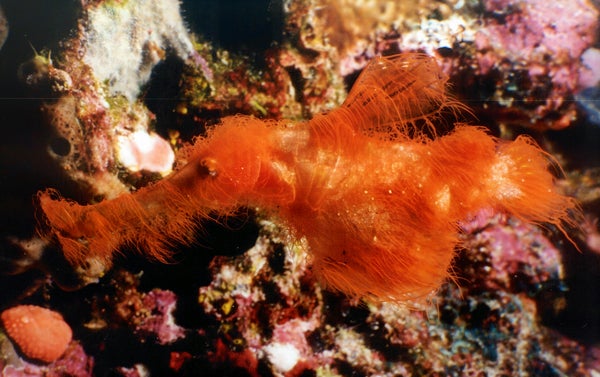
For decades a tiny fish haunted marine biologist David Harasti. During a dive off Papua New Guinea in 2003, he caught a glimpse of something red and shockingly hairy and immediately knew it was something scientists hadn’t yet described. But from there, things got trickier: during six more visits, he couldn’t find it again. It took enlisting Great Barrier Reef divers and scouring the shelves of the Australian Museum to determine that the fish wasn’t imaginary. Finally, scientists have confirmed the new species—and enshrined it in the annals of science as Solenostomus snuffleupagus, a nod to its remarkable resemblance to Big Bird’s beloved friend.
“It was so easy to say, ‘Yeah, this looks like Snuffleupagus.’ I mean, it’s almost identical. It’s scary,” says Graham Short, an ichthyologist and taxonomist at the California Academy of Sciences and the Australian Museum, who, with Harasti, wrote the paper formally describing the new species. “We may have had a few drinks and decided to e-mail Sesame Street Australia. And they answered the following day!”
On supporting science journalism
If you're enjoying this article, consider supporting our award-winning journalism by subscribing. By purchasing a subscription you are helping to ensure the future of impactful stories about the discoveries and ideas shaping our world today.
S. snuffleupagus, which measures between one and 1.5 inches long and is found in the southwest Pacific Ocean, is now the seventh known species of ghost pipefish. These animals are relatives of seahorses and known for their remarkable camouflage—likely the evolutionary function of the new species’ dramatic look. “They resemble bits of floating red algae,” Short says. “You can easily see a lot of divers going by this fish and not realizing it’s an actual fish.”
But a fish it indeed is—albeit a mysterious one. Scientists don’t know much about ghost pipefishes in general, Short says, and have mostly operated off observations from divers. Like seahorses, females are larger and males brood eggs, Short says. CT scans taken by him and other researchers have found skeletons of smaller fishes in the guts of ghost pipefishes, including S. snuffleupagus. “For such a cute little thing, it’s actually a predator,” Short says.
The scientists considered several traits to confirm that S. snuffleupagus is its own critter, not a known species in disguise. The CT scans, for example, revealed that the new species had more vertebrae than its relatives. An analysis of its mitochondrial DNA suggested that S. snuffleupagus diverged from its closest relative some 18 million years ago.
And then, of course, there’s the obvious. “It’s so hairy compared to other species,” Short says. It’s not mammalian hair but what scientists call filaments on the hard, bony plates that act almost as an exoskeleton for ghost pipefishes, which don’t have traditional fish skin.
“Other species can be a little bit hairy in certain spots, like under the snout,” he says. “But this one took the hairy form all the way. I mean, it looks ridiculous.”