
Timing is crucial when it comes to treating a stroke, because tissue surrounding a clot can die rapidly after blood flow is blocked in the brain. For nearly two decades the only drug approved by the U.S. Food and Drug Administration for ischemic stroke was the clot-busting tissue plasminogen activator (tPA). Although highly successful in many patients, this treatment has some key limitations: It can only be used within a brief time window—up to four and a half hours after stroke onset—and it is not as effective in dissolving larger blood vessel blockages, which can cause more extensive brain damage.
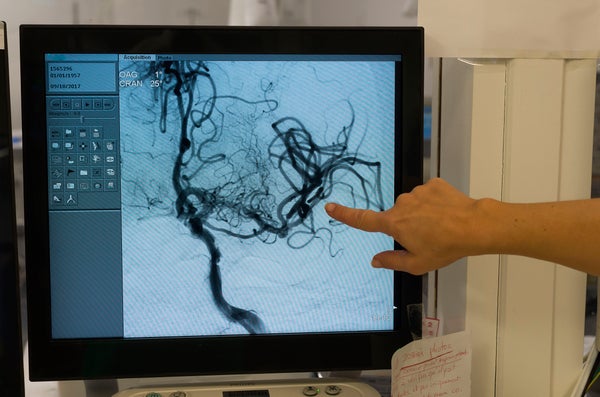
A breakthrough came in 2015 when five trials in The New England Journal of Medicine reported promising results for a new, highly effective technique: thrombectomy. By guiding a medical device from an artery in the leg up to the stroke site, physicians could physically remove blood clots from the brain. This procedure was revolutionary for two reasons: It proved to be much more effective than tPA for larger clots, and it lengthened the period during which stroke treatment was possible by up to six hours. “I think we’re entering a new era in stroke therapy with this mechanical device,” says Gregory Bix, a neurologist at the University of Kentucky.
Return to read about attempts to protect brain cells in the aftermath of a stroke. Credit: Getty Images
On supporting science journalism
If you're enjoying this article, consider supporting our award-winning journalism by subscribing. By purchasing a subscription you are helping to ensure the future of impactful stories about the discoveries and ideas shaping our world today.
Earlier this year researchers demonstrated in two trials, called DEFUSE 3 and DAWN, that the time window could be stretched more: up to 24 hours after stroke onset. This was possible because RAPIDimaging software enabled physicians to better identify which patients would benefit from the treatment, by revealing how much of their brains were still salvageable after stroke. “The rate of death of the brain tissue is going to depend on what other blood vessels are able to help out,” notes Gregory Albers, a neurologist at Stanford University who was involved in developing RAPID. “In some people, their blood vessels are hooked up in a way that makes them very good at helping out when another one is in trouble. And in other people, they’re not.”
Albers thinks the time window could be extended even further. He and his colleagues found that in the DEFUSE 3 trial, around 20 percent of patients within the control group—those who did receive thrombectomies—had salvageable brain tissue up to 39 hours after stroke onset. “This goes completely against what we’re taught in medical school,” Albers says. “The mantra ‘time is brain’ doesn’t include the idea that you can salvage a small percentage of patients at 39 hours.”