A River Once Ran through the Sahara [Graphic]

In full flow it would rank 11th among the largest rivers today

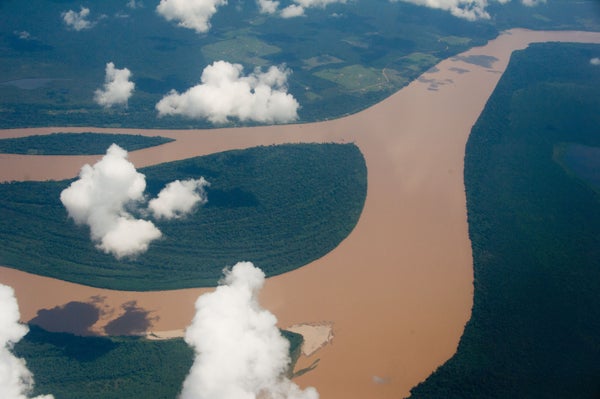
Aerial view of the Amazon river.

CHRISTOPHE SIMON/AFP/Getty Images

Join Our Community of Science Lovers!


On supporting science journalism

If you're enjoying this article, consider supporting our award-winning journalism by subscribing. By purchasing a subscription you are helping to ensure the future of impactful stories about the discoveries and ideas shaping our world today.


No one ever says of the Sahara that a river runs through it. But somewhere between 11,700 and 5,000 years ago, one did. In full flow, it would rank 11th among the largest rivers on the earth today.* Paleoclimatologist and geochemist Charlotte Skonieczny of the French Research Institute for Exploration of the Sea and her colleagues report the evidence for the ancient channel in a recent issue of Nature Communications. The team discovered the so-called Tamanrasett River when examining microwave data collected by a Japanese satellite that had been mapping geologic features in the area. The hidden bedrock valley winds for more than 500 kilometers from the Atlas Mountains in northern Africa to the Atlantic Ocean.

*CHARLOTTE SKONIECZNY AND HER COLLEAGUES HAD PLACED THE RIVER AS THE 12TH LARGEST, PER DIFFERENT ESTIMATES OF RIVER AREA SIZES; SOURCES: “AFRICAN HUMID PERIODS TRIGGERED THE REACTIVATION OF A LARGE RIVER SYSTEM IN WESTERN SAHARA,” BY C. SKONIECZNY ET AL., IN NATURE COMMUNICATIONS, VOL. 6, ARTICLE NO. 8751; NOVEMBER 10, 2015 (illustration of Tamanrasett); “GEOMORPHOMETRIC ATTRIBUTES OF THE GLOBAL SYSTEM OF RIVERS AT 30-MINUTE SPATIAL RESOLUTION,” BY C. J. VÖRÖSMARTY ET AL., IN JOURNAL OF HYDROLOGY​, VOL. 237, NOS. 1–2; OCTOBER 25, 2000 (area and length of Tamanrasett); ENCYCLOPÆDIA BRITANNICA www.britannica.com (area and length of all other rivers)
Illustration by Amanda Montañez

Shannon Hall is an award-winning freelance science journalist based in the Rocky Mountains. She specializes in writing about astronomy, geology and the environment.

More by Shannon Hall
Scientific American Magazine Vol 314 Issue 5This article was published with the title “Deserted Waters” in Scientific American Magazine Vol. 314 No. 5 (), p. 14
doi:10.1038/scientificamerican0516-14

It’s Time to Stand Up for Science

If you enjoyed this article, I’d like to ask for your support. Scientific American has served as an advocate for science and industry for 180 years, and right now may be the most critical moment in that two-century history.

I’ve been a Scientific American subscriber since I was 12 years old, and it helped shape the way I look at the world. SciAm always educates and delights me, and inspires a sense of awe for our vast, beautiful universe. I hope it does that for you, too.

If you subscribe to Scientific American, you help ensure that our coverage is centered on meaningful research and discovery; that we have the resources to report on the decisions that threaten labs across the U.S.; and that we support both budding and working scientists at a time when the value of science itself too often goes unrecognized.

In return, you get essential news, captivating podcasts, brilliant infographics, can't-miss newsletters, must-watch videos, challenging games, and the science world's best writing and reporting. You can even gift someone a subscription.

There has never been a more important time for us to stand up and show why science matters. I hope you’ll support us in that mission.

Thank you,

David M. Ewalt, Editor in Chief, Scientific American

Subscribe