January 14, 2011
1 min read
 Add Us On GoogleAdd SciAm
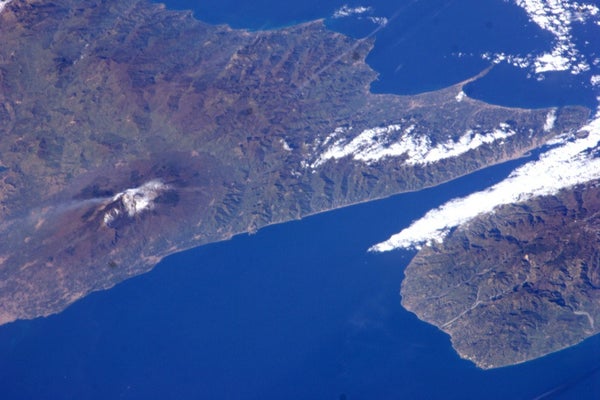
A Sicilian volcanic eruption photographed from the space station
Mount Etna, which has a long rap sheet of eruptions stretching back more than 2,700 years, is still at it.
On supporting science journalism
If you're enjoying this article, consider supporting our award-winning journalism by subscribing. By purchasing a subscription you are helping to ensure the future of impactful stories about the discoveries and ideas shaping our world today.
Mount Etna, which has a long rap sheet of eruptions stretching back more than 2,700 years, is still at it. The 3,300-meter volcano on the island of Sicily remains a highly active volcano, erupting several times in just the past decade.
The restless volcano began oozing lava once again on January 12, according to Italy's National Institute of Geophysics and Volcanology. No injuries were reported, according to United Press International, but Etna's plume did force the temporary closure of a Sicilian airport. Etna's activity has not always been so benign; a 1669 eruption killed an estimated 20,000 people.
As the International Space Station cruised over southern Europe on January 14, Italian astronaut Paolo Nespoli of the European Space Agency got a firsthand look at his home country's tallest volcano. Nespoli snapped the above photograph from orbit, about 350 kilometers above Earth. Etna's plume is visible trailing off to the left; the landmass on the right side of the image is the tip of the Italian mainland.
It’s Time to Stand Up for Science
If you enjoyed this article, I’d like to ask for your support. Scientific American has served as an advocate for science and industry for 180 years, and right now may be the most critical moment in that two-century history.
SciAm always educates and delights me, and inspires a sense of awe for our vast, beautiful universe. I hope it does that for you, too.
If you subscribe to Scientific American, you help ensure that our coverage is centered on meaningful research and discovery; that we have the resources to report on the decisions that threaten labs across the U.S.; and that we support both budding and working scientists at a time when the value of science itself too often goes unrecognized.
In return, you get essential news, captivating podcasts, brilliant infographics, can't-miss newsletters, must-watch videos, challenging games, and the science world's best writing and reporting. You can even gift someone a subscription.
There has never been a more important time for us to stand up and show why science matters. I hope you’ll support us in that mission.