
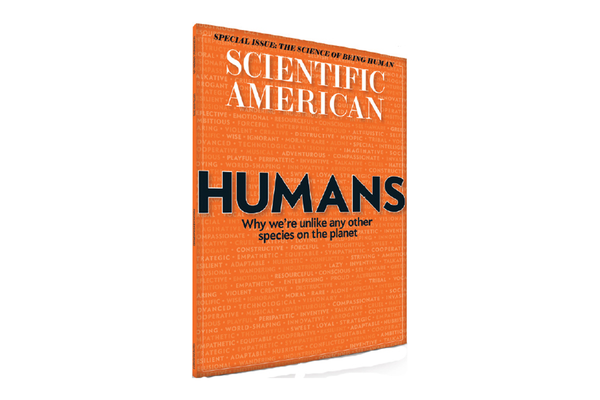
“What a piece of work is a man,” proclaimed Hamlet in the play of the same name, partly in admiration over our nobility and intelligence, partly in despair over our flaws. We Scientific American editors have to agree with Shakespeare's sentiments, and in this special single-topic issue, we join him in his apparent obsession to try to understand our species anyway.
We do have the benefit of perspective gained from the process of science instead of relying on storytelling alone. For instance, there's the matter of how Homo sapiens came to be the only human species on the earth when we were once just one of a diverse array of bipedal species. In her article, “Last Hominin Standing,” senior editor Kate Wong paints the picture of our rise.
Although we do seem to share many cognitive traits with animals, our intellectual capabilities have no equal on this planet (“Inside Our Heads”). Humans are apparent standouts because of the richness of our subjective experience (“The Hardest Problem”) and an ability to communicate thoughts to others (“Talking through Time”). A defining characteristic of our species is that we can transmit knowledge from one generation to the next and then build and innovate on these cultural bequests from our ancestors. All of this, in turn, selects for better cognitive skills and bigger brains (“An Evolved Uniqueness”). We demonstrate our communal cleverness by devising machines that combine numerous past innovations. The internal-combustion engine is just such a stellar example (“Techno Sapiens”). As a species whose members number in the billions and are extensively settled across nearly all the continents, we have an inclination to establish norms and conventions that regulate our behavior when living in large groups (“The Origins of Morality”).
On supporting science journalism
If you're enjoying this article, consider supporting our award-winning journalism by subscribing. By purchasing a subscription you are helping to ensure the future of impactful stories about the discoveries and ideas shaping our world today.
Looking ahead, we may even, through AI, or artificial intelligence, design a master algorithm that could enable models of ourselves to act as the ultimate personal assistant that performs many of our everyday tasks (“Our Digital Doubles”). As we continue an influx into cities, animals around us are necessarily adapting rapidly to a more urban world (“Darwin in the City”). Seeds are reshaping on dandelions. Instead of being distributed on the winds, they drop straight down onto precious, limited soil. Peregrine falcons are settling in, snapping up plentiful pigeons. What is to come? Perhaps only we can imagine where the complex changes we've set in motion may lead. And if we don't like what we envision, only we have the knowledge and the power to refashion the world for a more hopeful future. That's an awful lot of responsibility for a physically weak, though cognitively powerful, biped, but we'll have to shoulder it.