
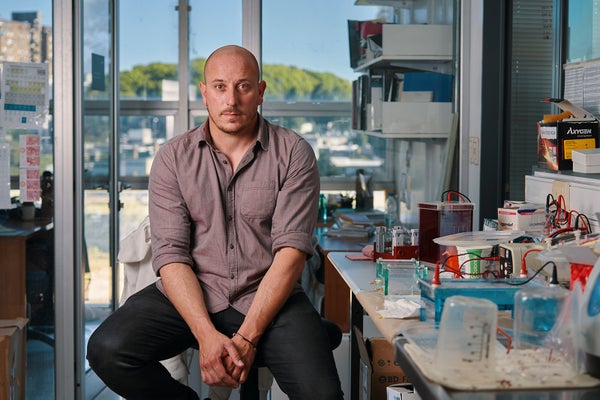
Fame came quickly for Gonzalo Moratorio during the COVID-19 pandemic. People recognize him on the streets of Uruguay’s capital, Montevideo. They buy him a beer every now and then when he goes to a bar. They even approach him on the water, whenever he goes out surfing with friends. And they thank him.
They are grateful because Moratorio helped Uruguay dodge the worst consequences of the pandemic. He was named one of Nature’s 10: 10 people who helped shaped science in 2020. Moratorio, a virologist at the Pasteur Institute and the University of the Republic, both in Montevideo, and his colleagues designed a coronavirus test and a national program for administering it that has helped to keep COVID-19 cases at bay as outbreaks have swept through Latin America—including Uruguay’s closest neighbors, Argentina and Brazil. Uruguay continues to record a relatively low number of deaths, though both the country’s mortality and new case figures have risen during the last month, as they have for many countries.
The number of deaths on December 4 reached 80 people, but rose to 217 by January 6. Uruguay, however, is still doing far better than some of its neighbors in the Americas (measured in deaths per 100,000 people). “We’re buying time,” he says. “And all the time we buy will be precious until drugs or vaccines arrive.”
On supporting science journalism
If you're enjoying this article, consider supporting our award-winning journalism by subscribing. By purchasing a subscription you are helping to ensure the future of impactful stories about the discoveries and ideas shaping our world today.
Moratorio was excited to start 2020 as head of his own laboratory for the first time, having completed a postdoc in Paris in 2018. He was planning to study how viruses mutate and how to make them less harmful. But in the first days of March, he and other Pasteur researchers from across the Americas met online to discuss what to do about the rapidly growing coronavirus outbreak.
Some researchers weren’t terribly worried. Carlos Batthyány, a pharmacologist who leads the Pasteur Institute of Montevideo, told his colleagues that he thought Uruguay would be largely spared by the pandemic. “I wasn’t very convinced of the impact it would have,” he says.
His confidence made sense. Uruguay—a country with universal health care, a robust epidemiological surveillance system and a relatively small population, of 3.5 million—has mostly evaded yellow fever, Zika and other infectious diseases that have plagued its neighbors.
But Moratorio understood the risk. “Gonzalo dashed out of the meeting and got to work,” says Batthyány. “When he’s convinced that something needs to be done, he knocks down mountains. He’s a Don Quixote in that way.”
Moratorio saw that the way to avoid spiralling outbreaks was to test widely and to isolate positive cases. But it wasn’t long before global demand for commercial diagnostic kits surged. He and his long-time collaborator, virologist Pilar Moreno, knew that the resulting shortage would make it impossible for Uruguay to procure tests and reagents. “It was at that point that we realized that we had to somehow become independent,” says Moreno.
On March 13, the country confirmed the first COVID-19 cases and declared a health emergency. The government shut down businesses and schools, announced restrictions on flights and border crossings and asked people to isolate themselves. By then, Moratorio, Moreno and their lab members had developed their own test, which uses the gold-standard technique polymerase chain reaction (PCR) to detect molecular signatures unique to SARS-CoV-2.
Within a few weeks, the researchers had transformed their test into a simple and efficient kit, with just three tubes, and taking up only one well in a PCR machine. And with the help of the Ministry of Public Health, they trained and created a national network of COVID-19 diagnostic labs.
By the end of May, Uruguay was performing more than 800 tests per day, and about half of the kits were produced domestically. Today, that number is around 5,000—of which about 30% use Moratorio’s assay. The speed and coordination of Uruguay’s response was impressive, says Zulma Cucunubá, an infectious-disease epidemiologist at Imperial College London. “Let’s just say one feels envious that Uruguay achieved that very early.”
Life in Uruguay has mostly gone back to normal. Schools and restaurants have reopened, and many people are back at work. Even Moratorio and his team have slowly returned to their original research. But he remains alert. “Let’s hope it lasts,” he says. “My fear is that we won’t be able to contain this at some point.”
This article is reproduced with permission and was first published on January 6 2021.