
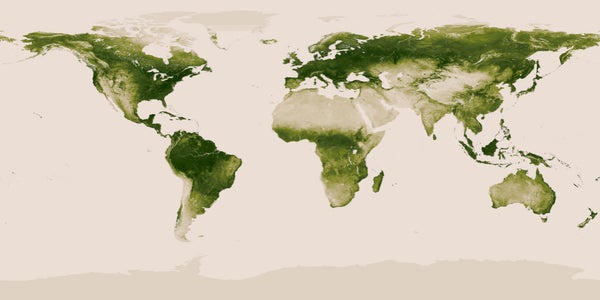
New satellite images show the ebb and flow of Earth's vegetation over the course of a year. Starting April 2012 the National Oceanic and Atmospheric Administration (NOAA) collected satellite data for one year to monitor the green places on our planet. The pictures come to life in a beautiful movie that compresses a year on our home world into a few minutes.
The photos show diverse natural and man-made activity: scars from wildfires near Langepas, Russia; plants clinging to the banks of the Nile; deforestation in South America; transformation of the Florida Everglades to farming and conservation land; urban sprawl around major cities. Lush vegetation appears dark green whereas lighter colors indicate snow, deserts and cities.
NOAA captured the data with the VIIRS instrument (Visible Infrared Imager Radiometer Suite) onboard the Suomi NPP (National Polar-orbiting Partnership) satellite.
On supporting science journalism
If you're enjoying this article, consider supporting our award-winning journalism by subscribing. By purchasing a subscription you are helping to ensure the future of impactful stories about the discoveries and ideas shaping our world today.
Suomi NPP's orbit takes it over the poles 14 times a day. A polar orbit lets the satellite image the entire globe and take pictures of the same spot twice daily. The photos provide scientists with data to predict drought, monitor wildfires, forecast weather and disease outbreaks, and make better land management decisions.
Launched in October 2011, SNPP is the first of four polar-orbiting satellites, operated jointly by NOAA and NASA, built to advance environmental monitoring. The next mission is scheduled to launch in early 2017.
—Christopher Crockett