
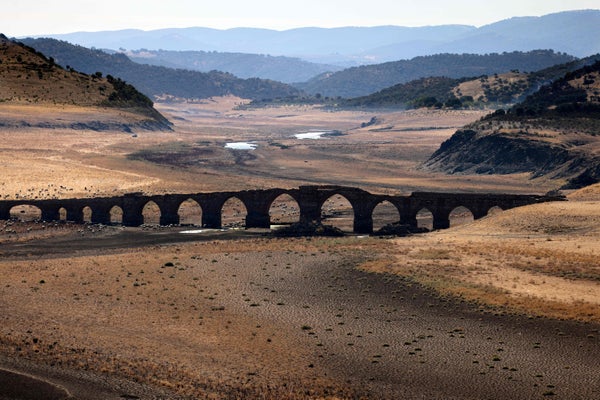
Severe drought choked much of the Northern Hemisphere this summer, from China to Europe to the western United States. Scientists say climate change is at least partly to blame.
Climate change increased the odds of drought across the hemisphere by as much as 20 times, according to a new study from the research consortium World Weather Attribution, which specializes in the links between climate change and extreme weather events.
Zeroing in specifically on Europe, which saw one of its driest summers in decades, climate change may have made the drought three to four times more likely to occur.
On supporting science journalism
If you're enjoying this article, consider supporting our award-winning journalism by subscribing. By purchasing a subscription you are helping to ensure the future of impactful stories about the discoveries and ideas shaping our world today.
The study was released Wednesday, just weeks after the summer’s end.
It’s the latest in a series of “rapid attribution studies” from World Weather Attribution, which this summer has examined the role of climate change on heavy rainfall in Brazil, record-breaking heat in the U.K. and devastating floods in Pakistan.
In this case, the researchers conducted two analyses: one focusing on most of the Northern Hemisphere, aside from the tropical regions, and one looking specifically at west-central Europe. Europe saw its hottest summer on record this year, and it experienced its driest conditions since 1950.
Drought can be defined in a variety of ways, from low rainfall to low river flows. In this study, the researchers looked at the dryness of the soil—a critical factor in plant growth. Low soil moisture is sometimes referred to as agricultural or ecological drought.
They found that in both study regions—in Europe and in the Northern Hemisphere at large—this summer’s drought was about a one-in-20-year event. That’s an event with about a 5 percent chance of occurring in any given year.
Looking at historical data, the researchers found that the odds of these kinds of severe droughts have increased over the last century. The researchers then used climate models to determine whether global warming was part of the reason why.
The models suggest that climate change has, in fact, played a role. Warming has made this summer’s level of drought around three to four times more likely to occur in Europe, and as much as 20 times more likely across the Northern Hemisphere.
Those are the best estimates, according to the model results. That said, there’s a lot of uncertainty around those numbers. That’s partly because drought is a fairly complex weather phenomenon compared to other events like heat waves or extreme rainfall, and soil moisture is also comparatively difficult to observe, quantify and reproduce in models.
Although the exact numbers might be up for debate, the researchers firmly conclude that climate change did play a major part.
“There is absolutely no doubt that climate change did play a big role here,” said Friederike Otto, a climate scientist at Imperial College London and co-lead of World Weather Attribution. “The exact quantification of that role is more uncertain for soil moisture than, for example, when we look at heavy precipitation.”
The study also uses climate models to take a look into the future. The world has already warmed by about 1.2 degrees Celsius—and if the planet hits 2 C, the odds of severe drought will increase even further. In some parts of the Northern Hemisphere, the likelihood could increase by as much as 15 times.
“That means the current one-in-20 year event will occur almost every year,” said Dominik Schumacher, a scientist at the Swiss Federal Institute of Technology Zurich and one of the study’s authors.
Reprinted from E&E News with permission from POLITICO, LLC. Copyright 2022. E&E News provides essential news for energy and environment professionals.