
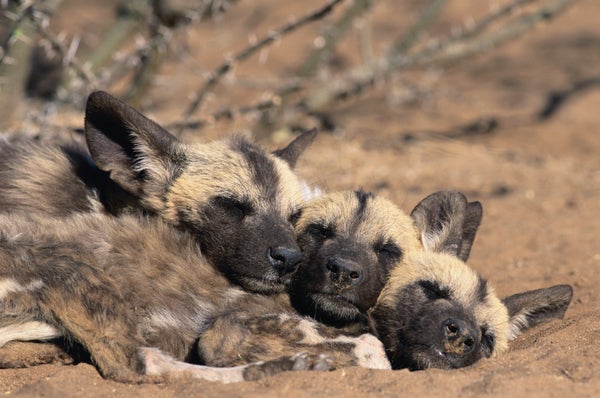
CLIMATEWIRE | The African wild dog could be headed for a population crash because of how it’s adapting to climate change.
An analysis of 30 years of demographic data and field observations in Botswana reveals that the endangered species, a distant relative of wolves, is experiencing higher pup mortality as rising average temperatures affect its annual denning season.
Researchers call the condition a “phenological trap,” where a species shifts the timing of major life events as a response to environmental change. The African wild dogs have experienced a 22-day shift in their birthing season, triggered by a shrinking cool season, according to the new study in the Proceedings of the National Academy of Sciences.
On supporting science journalism
If you're enjoying this article, consider supporting our award-winning journalism by subscribing. By purchasing a subscription you are helping to ensure the future of impactful stories about the discoveries and ideas shaping our world today.
New litters traditionally are born during the coolest time of the year, between May and July, to reduce exposure to spring heat. But as the birthing season shifts later under warming, the pups experience greater stress at their critical early life stage.
The result: Fewer pups live through their first year of life.
“It is an unfortunate ‘out of the frying pan, into the fire’ situation,” said Briana Abrahms, the study’s lead author, who is an assistant professor of biology at the University of Washington and researcher with the Center for Ecosystem Sentinels.
The study, supported by the nonprofit Botswana Predator Conservation, reflects scientists’ growing understanding of how apex species like wild dogs, among the hardiest carnivores in sub-Saharan Africa, are still at risk of a population crash as the climate warms.
“Results suggest that climate-driven shifts could be more widespread among top predators than previously appreciated, and they demonstrate how climate change can affect top-down influences on ecosystems by changing the ecology of uppermost trophic levels,” researchers wrote.
Instead of adapting, species like the wild dog “maladapt,” Abrahms said, meaning their core instincts to survive climate change have the exact opposite effect.
“We don’t know exactly how the hotter temperatures are related to decreased pup survival,” Abrahms said in an interview. What researchers do know is that the pups stay with their mothers later into the denning season, shifting pack dynamics. “It may have something to do with their ability to get food from the rest of the pack,” she said.
The leading cause of death for African wild dog pups is starvation, followed by lion predation.
The International Union for Conservation of Nature estimates that roughly 1,400 adult African wild dogs remain in the wild, and that number is declining. A pack can range in size from 10 to 40 animals, experts say.
The animals, recognizable by their mottled black, brown and white coats and pronounced ears, are often mistaken for hyenas and killed by farmers. However, they are most threatened by habitat fragmentation and human encroachment, according to the African Wildlife Foundation. Their traditional range extends from southern East Africa to southern Africa.
Reprinted from E&E News with permission from POLITICO, LLC. Copyright 2022. E&E News provides essential news for energy and environment professionals.