
Recent research suggests listeners often struggle to distinguish music made by artificial intelligence from human-made songs—a sign that the technology has moved past novelty and into serious business.
In late February Suno, an AI music company based in Cambridge, Mass., announced it had reached $300 million in annual recurring revenue and two million paying subscribers, even as artists and record labels have continued to challenge how the technology was built and what it might replace.
Suno generates songs from written prompts, and it increasingly allows users to shape the results with lyrics, uploaded audio and voice samples. Paying subscribers get more control. Since last September Suno Studio, the company’s premium offering, has allowed users to manually edit its generated tracks. In March the company rolled out Voices, which lets subscribers generate songs using AI versions of their own voices.
On supporting science journalism
If you're enjoying this article, consider supporting our award-winning journalism by subscribing. By purchasing a subscription you are helping to ensure the future of impactful stories about the discoveries and ideas shaping our world today.
Suno says more than 100 million people have accessed at least its free version. In a November 2025 post on the company’s blog, its CEO Mikey Shulman wrote that many were doing so “for the first time in their lives.” Existing musicians, from students to professionals, also use Suno to test ideas quickly, hear melodies in different styles and generate musical fragments for use in larger works.
“Our tools are designed to expand what people can create—to amplify the instinct, taste and feeling that only a person brings to music,” the company said in a statement.
For some musicians, the attraction is flexibility. Los Angeles musician and producer Yannick “Thurz” Koffi and collaborators recently used Suno to generate snippets in the styles of different eras and then used that material in place of the samples of existing songs often used in hip-hop. “We’re able to just use different elements from these generations and then throw them into our new compositions,” he says, “and make a bed for artists to jump in and create new ideas.”
That promise comes with a legal fight at the center of the industry. Artists and record labels say Suno was trained on copyrighted recordings without permission or compensation. In court, the company acknowledged that building its system required showing the model “tens of millions of recordings” but argued that such training is protected as fair use.
Similar legal challenges abound. Warner Music Group settled with Suno last November. Rival company Udio reached deals with Warner and Universal Music Group. But Suno remains in conflict with Universal and Sony, and Google’s Lyria 3 is now facing its own lawsuit from indie musicians. Ron Gubitz, executive director of the Music Artists Coalition, which counts Don Henley and Meghan Trainor among its board members, says musicians want to know how their work is being used, to be able to withhold consent and to be fairly paid. “We’re not anti-AI,” he says. “We just want to make sure that this is done fairly.”
Critics also worry that AI-generated songs will compete with human-made music for listeners’ finite attention—and the limited pot of royalties paid to artists by music streaming services. Suno’s own marketing material for its Suno Studio feature promotes the ability to generate instrument tracks that match an existing composition’s style, key and tempo, eliminating “the need to hire session musicians for missing parts.” (Suno later clarified that this language doesn't reflect the tool's intent.)
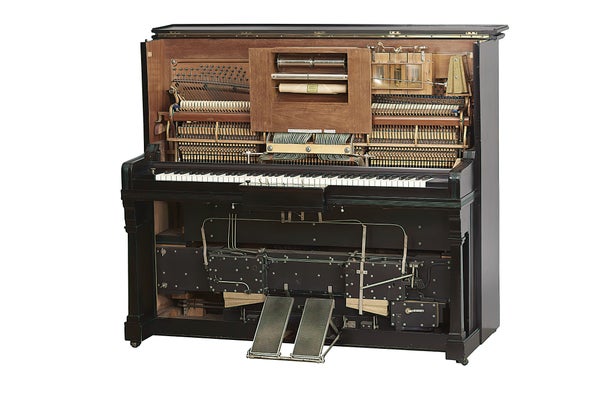
More than a century ago the rise of the player piano prompted strikingly similar debates about automation, artistry and fair compensation. Of all the technologies that have reshaped music, it is the closest historical parallel to AI: it used punched holes on rolled sheets of paper to reproduce music in the home without a pianist at the keys. In early models the operator pedaled a treadle that pushed air through the perforations, triggering the notes.
Like today’s text-to-song systems, the player piano promised polished musical output for people with little or no training. “People think of digital as this new thing,” says Allison Wente, an associate professor of music at Elon University, who studies the player piano and musical labor, “but really, the player piano is from the 1880s.”
At the turn of the 20th century, that automation changed what a piano in the home could do. A family that owned an upright but lacked a skilled player could suddenly fill a room with ragtime or Bach without anyone learning how to find middle C. Advertisements sold the machine as a way to produce quality music instantly, “without the least preparatory study,” as one 1909 ad read. The pitch rings familiar now: access, ease and professional-sounding results for amateurs.
And, like AI today, it provoked fears about what would happen to human skill. In a 1906 essay, composer John Philip Sousa warned that technologies like the player piano and the phonograph would make children “indifferent to practice” and erode amateur musicianship.
The worst predictions did not fully come true. Player pianos did not put concert pianists or music teachers out of work. Some composers embraced piano rolls; some even wrote music specifically for them. The technology even created new forms of musical labor to record performances and punch the paper rolls, and it served as a practice aid for young musicians including Fats Waller and Duke Ellington.
Christopher White, an associate professor of music theory at the University of Massachusetts Amherst and author of a 2025 book on AI music, notes that the next generation of trained musicians is far from enthusiastic. “You won’t meet a group of people who are more skeptical of generative musical AI than conservatory music students,” he says.
White suspects AI could even strengthen the appeal of live performance. But for recorded music, the outcome isn’t clear. AI music may end up a novelty like player pianos or a genuine substitute for human-made songs. The most immediate disruption may appear in commercial niches such as advertising jingles or podcast themes. “I think that most of those jobs are probably going to go away,” White says.
The legal parallels are just as close. In 1908, in White-Smith Music Publishing Co. v. Apollo Co., the U.S. Supreme Court held that piano rolls were “parts of a machine” rather than copies governed by copyright law. Congress changed the law the next year to require royalties for rolls and records. In a February paper, Douglas Lind and Adrienne Holz, both at Virginia Tech, argued that AI presents a similar problem now: a new technical process has moved faster than the legal means to regulate it.
That history suggests a pattern: the technology moves first, the rules follow, and the creative adaptation tends to surprise everyone. New technologies in music rarely destroy the old order as promised or feared. AI-generated music may create new forms of work even as it threatens old ones.