
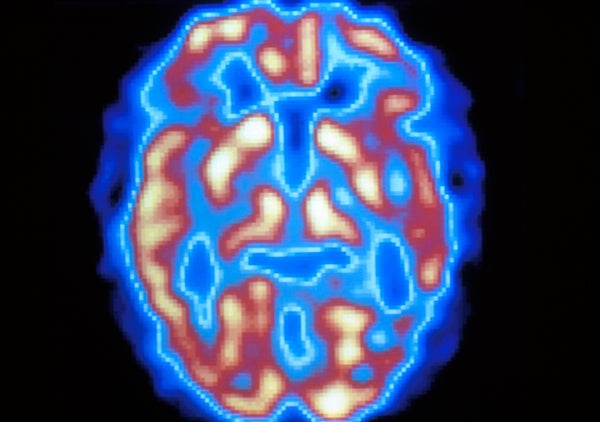
An estimated 5.7 million people in the U.S. have Alzheimer’s disease—the most common type of dementia—and that number is expected to more than double by 2050. Early diagnosis is crucial for patients to benefit from the few therapies available. But no single assay or scan can deliver a conclusive diagnosis while a person is alive; instead doctors have to conduct numerous clinical and neuropsychological tests. So there is growing interest in developing artificial intelligence to identify Alzheimer’s based on brain imaging.
Researchers at the University of California, San Francisco, have now successfully trained an AI algorithm to recognize one of the early signs of Alzheimer’s—a reduction in the brain’s glucose consumption—in positron emission tomography (PET) imaging. The algorithm accurately predicted an eventual Alzheimer’s diagnosis in nearly all the test cases, according to the study.
In PET imaging, trace amounts of a radioactive compound are ingested or injected into the body, producing three-dimensional images of metabolism, circulation and other cellular activity. PET is well suited for an AI diagnostic tool because Alzheimer’s causes subtle changes in the brain’s metabolism that begin years before neural tissue starts to degrade, says study co-author Jae Ho Sohn, a radiologist at U.C.S.F. These changes are “very hard for radiologists to pick up,” he notes.
On supporting science journalism
If you're enjoying this article, consider supporting our award-winning journalism by subscribing. By purchasing a subscription you are helping to ensure the future of impactful stories about the discoveries and ideas shaping our world today.
The algorithm was trained and tested on 2,100 PET brain images from about 1,000 people 55 years and older. The images came from a 12-year study that tracked people who would ultimately be diagnosed with Alzheimer’s, as well as those with mild memory declines and healthy control subjects. The algorithm was trained on 90 percent of the data and tested on the remaining 10 percent. It was then retested on a second, independent data set from 40 patients monitored for 10 years. The algorithm was highly sensitive and was able to recognize 81 percent of the patients in the first test group and 100 percent in the second who would be diagnosed with Alzheimer’s six years later, on average. The findings were published in February in Radiology.
The algorithm is based on “deep learning,” a machine-learning technique that uses artificial neural networks programmed to learn from examples. “This is one of the first promising, preliminary applications of deep learning to the diagnosis of Alzheimer’s,” says Christian Salvatore, a physicist at Italy’s National Research Council, who was not involved in the study. “The model performs very well when identifying patients with mild or late” diagnoses, he says, but catching it in the earliest stages “remains one of the most critical open issues in this field.”
Editor’s Note (5/8/19): This story was edited after posting to replace an image whose description could not be fully confirmed.