
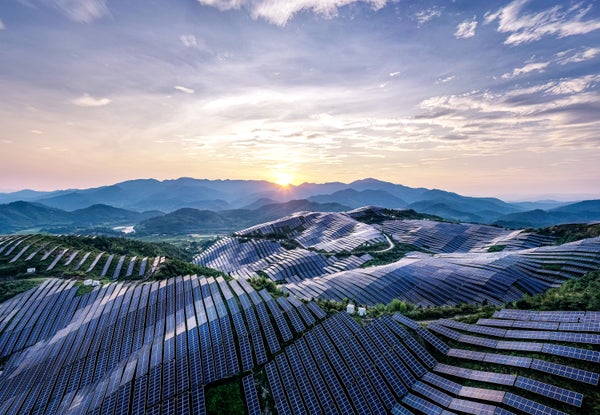
In 2015 I introduced a concept I called the “solar singularity”—the inflection point where solar power becomes cheaper than fossil fuels and thus the default choice for new electricity generation.
Every time the global capacity of installed solar panels doubled, prices fell about 20 percent (this is known as Swanson’s law). I argued we were around the midpoint toward almost 100 percent of global power coming from solar and other renewables, even though we were technically at only 1 percent then. By 2020, I suggested, renewables would dominate energy infrastructure worldwide, not because of environmental virtue or policy mandates but because of economics. Solar would take over.
And Bill McKibben’s recent book Here Comes the Sun confirms that the solar singularity has arrived largely as I predicted. Solar power has become cheaper than fossil fuels in most countries, and in 2024 renewables accounted for 92.5 percent of all new electricity generation globally. McKibben writes, “Solar power is growing faster around the world, not only than anything else right now, but than anything else ever.”
On supporting science journalism
If you're enjoying this article, consider supporting our award-winning journalism by subscribing. By purchasing a subscription you are helping to ensure the future of impactful stories about the discoveries and ideas shaping our world today.
California regularly produces more than 100 percent of its electricity from renewables during peak daylight hours. China has emerged as an electrostate, manufacturing solar panels and batteries at unprecedented scale.
But McKibben’s book overlooks a looming threat amid the celebration around renewables and reducing carbon-based energy use: the electricity demands of artificial intelligence data centers. The collision between the clashing exponential curves of renewable energy supply and AI energy demands will determine not just the trajectory of the global energy system but whether the renewable energy transition succeeds before another technology consumption binge derails it entirely.
We need to slow or stop the mad rush to build new AI data centers everywhere, no matter the harms or the costs. We have maybe three to five years to make serious changes. The question is whether AI’s exponential energy appetite will grow faster than we can deploy renewables, forcing us back toward fossil fuels or creating energy scarcity that limits both technologies.
AI is already a massive energy hog. U.S. data centers consumed 183 terawatt-hours (TWh) of electricity in 2024—equivalent to the entire power demand of Pakistan. With demand growing 16 percent in 2025 alone, consumption is projected to reach 325–580 TWh by 2028, with AI driving the bulk of that growth. AI-optimized servers are growing at 30 percent annually, and by 2028 more than half of all data center electricity will go to AI—enough to power 22 percent of American households.
But there is more coming. In January 2025 OpenAI, SoftBank, Oracle and MGX announced the Stargate Project—a $500-billion AI infrastructure initiative spanning four years (though recent funding disputes among the partners may push back the timetable). Separately, Meta, Amazon, Alphabet and Microsoft collectively committed $320 billion to AI infrastructure in 2025 alone, representing a 39 percent increase from 2024. These aren’t incremental expansions; they represent the largest private infrastructure investments in modern history.
Coming AI electricity demand is staggering: Microsoft and Constellation Energy announced a 20-year agreement to restart Three Mile Island’s Unit 1 exclusively to power AI data centers—the first commercial operation at the site since its 1979 accident. Amazon is building a 30-data-center facility in Indiana consuming 2.2 gigawatts. Meta’s Louisiana campus will increase that utility's energy demand by 30 percent. The Stargate facilities alone plan 10 gigawatts of capacity—equivalent to powering nearly 10 million homes.
Ireland serves as a striking canary in the coal mine. Data centers now consume 21 percent of the country’s electricity, with projections reaching 30 percent by 2030—meaning nearly one third of an entire nation’s power budget dedicated to server farms. In the U.S. mid-Atlantic and Midwest, where PJM Interconnection manages the grid, data center demand comprises 30 of the projected 32-gigawatt growth in peak load through 2030. Rates are rising accordingly.
According to REN21’s Global Status Report 2025, data centers and cryptocurrency mining drove a 20 percent increase in electricity demand (111 TWh) in 2024 alone, contributing 0.4 percent to total global electricity growth. Goldman Sachs projects AI will drive a 160 to 165 percent increase in data center power demand by 2030 compared with 2022 levels.
Several jurisdictions—Amsterdam, China, Germany, Ireland, Singapore and parts of the U.S.—have already introduced restrictions on new data center connections given grid capacity constraints.
When an AI called DeepSeek was able to do the same work as GPT-4 with 11 times less computing effort, it seemed at first that this would lead to more energy-efficient AI. Instead it incentivized AI developers to just make larger, more complex systems.
The International Energy Agency’s (IEA’s) projections illustrate institutional forecasting disconnect. The IEA projects data centers will account for about 3 percent of global electricity consumption by 2030—a “relatively modest” increase. But these projections assume incremental, distributed expansion. They don’t account for step-function scaling represented by megaprojects now under construction.
Stargate alone—10 gigawatts by 2025—represents the electricity consumption of 7.5 million homes. That’s one project from one consortium. When you add Meta’s $10-billion Louisiana facility, Microsoft’s $80-billion spend and Amazon’s $100-billion commitment, you’re looking at concentrated power demand that dwarfs distributed growth assumptions. If even half the announced megaprojects materialize, I have calculated that U.S. data center consumption could reach 15 to 20 percent of electricity demand by 2030. Globally, concentrated AI infrastructure could push data center consumption above 5 to 6 percent.
But the most immediate limit isn’t capital or chips—it’s power infrastructure. Grid operators are managing demand growing faster than transmission capacity can be built. Lead times for electrical equipment stretch beyond two years. While global percentages might seem manageable, concentration creates acute stress: Ireland reaching 21 percent and rising, utilities building power plants for single data center projects, grid operators implementing emergency curtailment procedures.
Despite evidence that exponential AI scaling is materializing, policy responses in the U.S. remain inadequate. There are no mandatory efficiency standards for AI training, no hard caps on computed energy use and no coordination between AI development and grid planning. Investment in fundamentally different computing approaches is minimal.
Instead we see reactive scrambling: utilities building gas plants for data center demand, grid operators implementing emergency procedures, regulators approving massive rate increases for infrastructure upgrades and ratepayers panicking at rising rates.
A little more than 10 years after I predicted the solar singularity in my book Solar: Why Our Energy Future Is So Bright, it has arrived on schedule. But it is being interrupted before it fully blossoms. The question isn’t whether solar, along with battery, storage becomes dominant—the economics are now irrefutable.
We face three potential paths forward: a fundamental shift in AI development away from compute scaling; energy resource conflicts as AI competes with human needs; or immediate policy intervention to prevent crisis. The exponential mathematics suggest we don’t have long before the collision between these curves forces radical changes.
What McKibben celebrated in 2025—and what I predicted a decade ago—may not survive the decade ahead unless we confront the AI energy tsunami with the same urgency we’ve finally brought to the climate crisis.
This is an opinion and analysis article, and the views expressed by the author or authors are not necessarily those of Scientific American.