
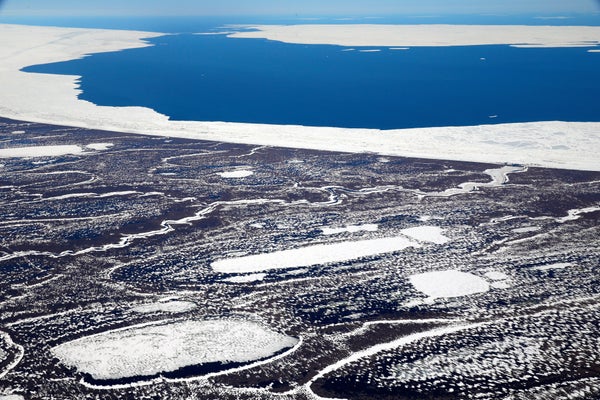
When federal climate scientists set about making their usual monthly tally of data from weather stations around the country in December, one station was glaringly missing: Utqiaġvik (formerly Barrow), Alaska, the northernmost community in the U.S.
After some digging the scientists found that month upon month of exceptionally warm temperatures had caused their automated quality-control checks to flag the data as suspicious. Basically, the computer algorithm they were using thought the warming over the past year was too rapid to be real.
But it turned out to be very real—and a stark example of the broader warming happening across the Arctic, where temperatures are rising at twice the global average. Through September 30, this year was the Arctic’s second warmest on record (behind only 2016), according to the 2017 Arctic Report Card, released this month by the National Oceanic and Atmospheric Administration. The unrelenting temperature rise and accompanying downward spiral of sea ice—which in turn amplifies that warming—“confirm that the Arctic shows no sign of returning” to its reliably frozen former state, Jeremy Mathis, director of NOAA’s Arctic Research Program, said at a press conference.
On supporting science journalism
If you're enjoying this article, consider supporting our award-winning journalism by subscribing. By purchasing a subscription you are helping to ensure the future of impactful stories about the discoveries and ideas shaping our world today.
It is the connection between sea ice and air temperatures that explains Utqiaġvik’s algorithm-breaking warming. Utqiaġvik sits on a peninsula along Alaska’s North Slope, flanked by the Bering and Chukchi seas, so ocean temperatures influence its climate more than they do in other North Slope locations. The longer the ocean stays ice-free, the more the water’s relative warmth affects Utqiaġvik.
Temperatures at the end of August were 4 degrees Celsius higher than average, and they stayed high through the typical fall freeze-up period. With hardly any sea ice even by the end of November, it is unsurprising that month was the community’s warmest November on record.
Fall temperatures in Utqiaġvik began their dramatic rise when the amount of sea ice there abruptly nose-dived around 2000. Ice levels seen in late November this year were typical of early or mid-October just 15 years ago, says Rick Thoman, climate science and services manager for the National Weather Service Alaska Region. In the 1970s those same ice levels would have been closer to what was typically seen in September, at the tail end of the summer melt season.
To NOAA’s quality-control algorithm—used to catch artificial jumps in temperature caused when weather stations are moved or new sensors introduced—the warming in Utqiaġvik finally reached the point where it was flagged as suspicious. “November was the straw that broke the algorithm’s back,” Thoman says.
The algorithm compares each station in the U.S. to neighboring ones to make sure their trends are similar. But when it comes to Utqiaġvik, the nearest stations are farther away and their temperature rises are not as pronounced. “The bottom line is that [the algorithms] assume gradual change,” Thoman notes. “And what we’ve had in the North Slope of Alaska, and really large parts of coastal Alaska, is really not a gradual change.”
The algorithm has now been fixed to treat Arctic stations differently than those farther south. Abrupt changes in sea ice and temperature could be observed at increasingly southern coastal locations in Alaska, Thoman says, as the Arctic continues to heat up at an unparalleled pace.