
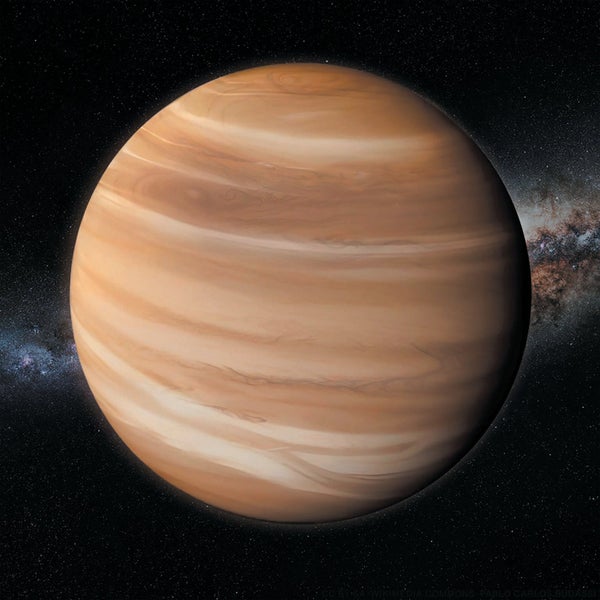
A bizarrely dense exoplanet located more than 500 light-years from Earth is challenging scientists' understanding of how planets form. This astronomical body, recently described in Nature, is the size of the ice giant Neptune but nearly 10 times heavier—meaning it is denser than steel.
“It's impossible for a planet like this to have formed by classical planetary formation models,” says lead study author Luca Naponiello, a Ph.D. candidate at the University of Rome Tor Vergata. Named TOI-1853 b, the planet is also oddly close to its sun; it rockets around the star once every 1.24 days. Neptune-size worlds are so rarely found in such tight orbits that astronomers have labeled these planet-sparse zones “hot Neptune deserts.”
The bigger mystery, though, is how TOI-1853 b got so dense. Astronomers think planets usually form “bottom-up,” with grains of rock and dust in a whirling protoplanetary disk glomming on to one another in ever larger clumps, eventually assembling a hefty core. But when that core reaches a certain critical mass, a buildup of pressure in the protoplanetary disk begins pushing additional planet-building material away, stifling further growth. TOI-1853 b seems to have somehow shot right past this limit—it has twice the amount of solid material that researchers believed could accumulate into a single object.
On supporting science journalism
If you're enjoying this article, consider supporting our award-winning journalism by subscribing. By purchasing a subscription you are helping to ensure the future of impactful stories about the discoveries and ideas shaping our world today.
If conventional models can't explain TOI-1853 b, what can? Naponiello and his co-authors propose two possibilities. First, the planet may have emerged from the collision of two preexisting protoplanets. Such collisions are expected in a planetary system's early epochs, but they are more likely to leave behind multiple planets than to result in a single, larger world, Naponiello says.
The second possibility is that TOI-1853 b began as a gas giant about the mass of Jupiter before losing most of its atmosphere to intense stellar radiation, ending up as a stripped-down solid core. Indeed, if this planet once had a sizable atmosphere, very little remains. That makes it unique even among Neptune-size planets, says astronomer Chelsea Huang of Australia's University of Southern Queensland. Huang finds the gas-giant theory particularly intriguing, as such planets' thick atmospheres typically obscure what's happening deeper inside. If TOI-1853 b once was a gas giant, then “this is the only way we can actually observe [a gas giant's] interior,” Huang says.
Future analysis of the planet's remaining atmosphere could reveal whether either of these hypotheses is correct. If TOI-1853 b was formed by collisions, researchers would expect its atmosphere to include water and other volatile compounds. If instead it was once a gas giant, they would expect to see a relatively thin, hydrogen-dominated atmosphere.