
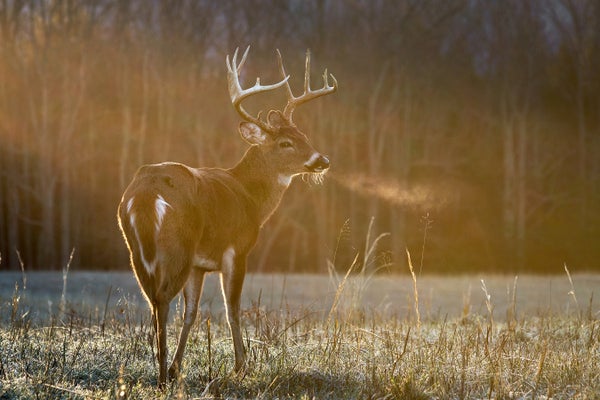
Using observational data and complex statistical analysis, a team of scientists has calculated how many mammals there are in the world and, more importantly, mammals’ total mass. Among other things, this work shows that almost half of the total biomass of wild mammals can be traced back to even-toed ungulates. This group of animals includes white-tailed deer, which are widespread in North America, and wild boar, which have a native range that extends from western Europe to eastern Asia and have benefited from the displacement of predators such as wolves.
Ron Milo of the Weizmann Institute of Science in Rehovot, Israel, and his team collected data on the global population of 392 land mammal species and recently published an analysis of that information in the journal Proceedings of the National Academy of Sciences USA. These 392 species with available data make up about 6 percent of all wild land mammal species. Using a machine learning model, the researchers then estimated the global population sizes of mammal species that do not have a precisely known distribution. The team found that wild land mammals weigh about 22 million metric tons altogether. Collectively, wild sea mammals weigh twice as much as wild land mammals. The lion’s share of this category is made up of baleen whales such as the fin whale, which has a biomass of eight million metric tons—around 60 percent of the aquatic mammals. The sperm whale, a type of toothed whale, also makes a significant contribution of seven million metric tons.
The researchers found that the number of individual animals making up a particular species provides no indication of the overall mass of that species. Bats have the highest estimated head count at almost 56 billion animals. Rodents, Milo’s team estimates, total 25 billion. At 0.5 million metric tons for bats and 1.1 million metric tons for rodents, however, the biomass of these mammals contributes practically nothing to the total mass count, the researchers found.
On supporting science journalism
If you're enjoying this article, consider supporting our award-winning journalism by subscribing. By purchasing a subscription you are helping to ensure the future of impactful stories about the discoveries and ideas shaping our world today.
The team writes that biomass can serve as an indicator of the abundance and ecological footprint of wild mammals on a global scale. Global data collection also helps identify trends that can answer researchers’ pressing questions: Are population sizes and species diversity changing? And if so, how much are they changing?
The research team also compared its estimates with the total number and mass of all mammals on Earth. Of this total mass, wild mammals make up just 6 percent. People, livestock and pets dominate the overall picture in every respect. Homo sapiens contributes a total weight of 390 million metric tons, which is slightly less than the weight of domesticated cattle at 420 million metric tons. Dogs rank fifth at 21 million metric tons but still constitute about as much mass as all wild land mammals combined.
When people observe the natural world, Milo and his team write, they tend to be guided by intuitive ideas—that the world is huge and its natural diversity surpasses everything created by humankind. With these estimates, the researchers hope to correct this erroneous picture.
This article originally appeared in Spektrum der Wissenschaft and was reproduced with permission.