
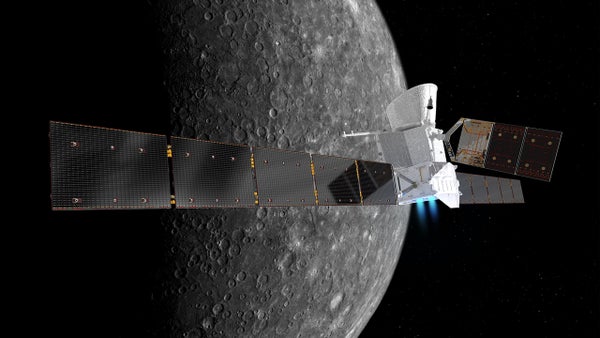
A European rocket is ready to launch the most ambitious mission ever taken towards Mercury, Earth’s once-neglected sibling in the Solar System.
The €1.6-billion (US$1.85-billion) expedition, carrying 2 robotic orbiters, ranks among the most expensive missions undertaken by the European Space Agency, and it includes Japan’s largest contribution yet to an international collaboration in space.
If all goes according to schedule, BepiColombo will lift off in the late hours of 19 October from the Kourou spaceport in French Guiana, atop an Ariane 5 heavy-launch vehicle.
On supporting science journalism
If you're enjoying this article, consider supporting our award-winning journalism by subscribing. By purchasing a subscription you are helping to ensure the future of impactful stories about the discoveries and ideas shaping our world today.
It will then embark on a seven-year journey to Mercury. When it gets there, the interplanetary spacecraft will release two probes into the planet’s orbit: the Mercury Planetary Orbiter (MPO), built by the European Space Agency (ESA), and the Mercury Magnetospheric Orbiter—nicknamed MIO and built by the Japan Aerospace Exploration Agency (JAXA).
The orbiters will investigate the mysteries of the innermost and smallest planet of the Solar System. Sun-baked Mercury was once thought to be a static, boring place. But in recent years, it has revealed many surprises, from its unusual magnetic field to water-ice deposits found in some of its craters.
Long road to here
BepiColombo was first conceived in the 1990s and has had a long and complicated gestation, says Johannes Benkhoff, its overall project scientist and a planetary physicist at ESA in Noordwijk, the Netherlands. That makes the team all the more eager as the final countdown approaches.
“It’s a great moment,” says Benkhoff, who has worked on BepiColombo for nearly 15 years. “Now it’s becoming real.”
Mercury is deep in the Sun’s gravitational well, which makes reaching it an enormous technical challenge. To get there, a spacecraft has to lose much of the momentum imparted to it by Earth’s orbital motion, so that it can fall towards the Sun.
But the spacecraft must also avoid overshooting, which would cause it to skim the Sun in a comet-like orbit. Because of these complexities, it takes eight times more energy—and several years longer—to travel to Mercury than to Mars. BepiColombo will use advanced, solar-powered ionic thrusters combined with gravitational assists from a total of nine fly-bys of Earth, Venus and Mercury itself.
Moreover, sunlight is ten times more intense at Mercury than it is in the outer space near Earth, and the planet’s nearly atmosphere-free surface reaches temperatures of 400 °C.
BEPICOLOMBO IN NUMBERS
1 Earth fly-by
2 Venus fly-bys
6 Mercury fly-bys before it arrives in its orbit on 5 December 2025
7 years to reach Mercury’s orbit
9 billion kilometres total travel distance
13 minutes maximum travel time for a one-way signal between the probe and Earth
60 kilometres per second fastest speed the probe will reach
240 million kilometres maximum distance between the probe and Earth
–180 °C to +450 °C temperature range the probe will experience at Mercury
Source: ESA
All these factors have made Mercury the least explored of the four planets of the inner Solar System: to this day, the only other probe to have entered Mercury’s orbit was NASA’s MESSENGER, which spent 4 years studying the planet between 2011 and 2015.
An older NASA Probe, Mariner 10, made several fly-bys of Mercury in 1974 without entering its orbit.
The upcoming Euro-Japanese mission is named after Giuseppe ‘Bepi’ Colombo, the late Italian scientist who studied Mercury and conceived of Mariner 10’s gravitational-assist trajectory.
Close encounter
BepiColombo’s two probes, MPO and MIO, will each have their own science priorities (see 'Journey to Mercury').
MIO will focus on the environment around Mercury—especially the magnetic field and its interaction with the solar wind.
MPO will primarily scan and map the planet’s surface, using instruments that can analyse most of the electromagnetic spectrum as well as neutrons that can reveal the chemical composition of the planet’s crust. MPO will study the gravitational field—and through that, the planet’s unusually large iron core—and also test some subtle predictions of Albert Einstein’s general theory of relativity.
MESSENGER had an oblong orbit that led it to fly relatively low over Mercury’s north pole, around 200 kilometres above, but as high as 10,000 kilometres above the planet’s southern hemisphere.
“The thing that’s really exciting about MPO is [its] low-orbit altitude,” says Nancy Chabot, a planetary scientist at the Johns Hopkins University Applied Physics Laboratory in Laurel, Maryland, who is a leading scientist for MESSENGER still working on data it collected. This will enable MPO to map the entire surface at high resolution.
MPO might even spot the 16-metre-wide crater that MESSENGER created when it dropped onto the surface at the end of its mission—potentially leaving interesting layers of rock exposed, Chabot says.
Chabot and her collaborators found compelling evidence for the presence of ice deposits in the permanently shaded areas of some craters near the north pole. The leading theory is that asteroids delivered the ice to the surface; a similar theory holds that much of Earth’s water came from a bombardment of asteroids or comets.
Further studies of the ice-filled craters—including some that might exist at the planet’s south pole—could even motivate a future mission that might include for the first time a lander. “Getting down to the surface is the next step,” says Chabot, who is part of a working group that will try to make the scientific case for such a mission.
Meanwhile, MIO will spin continuously to get a full-sky view of Mercury’s magnetosphere and the particles that wind around it, says MIO project scientist Go Murakami.
“Our particle sensors can cover almost [the entire] field of view,” says Murakami, a planetary scientist at JAXA’s Institute of Space and Astronautical Science in Sagamihara. The intense solar wind around Mercury might be comparable to the stellar wind around planets that closely orbit relatively cool red dwarfs—the most common stars in the Milky Way. So, studying Mercury could help scientists to understand what conditions might be conducive to life on extrasolar planets, Murakami says.
The BepiColombo probes are designed to last at least two years in orbit, although their mission could stretch a bit longer. But sooner or later, the heat will catch up with them, Benkhoff says. “Our time is limited. Mercury is a harsh environment.”
This article is reproduced with permission and was first published on October 15, 2018.