
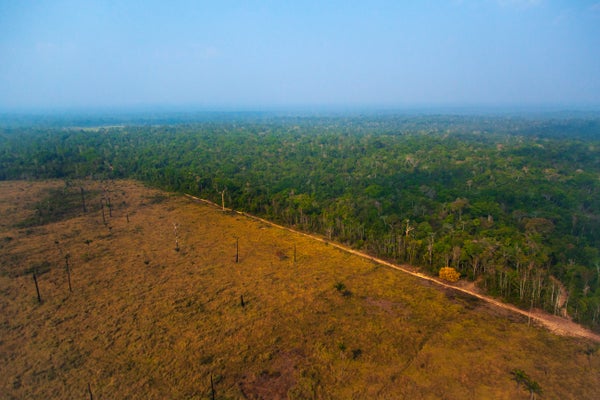
Indigenous people in the Brazilian Amazon with full ownership rights over their land saw a two-thirds decrease in the rate of deforestation on their land in the world's most important rainforest, a new study finds.
At issue is the impact of homologation — the final step in designating land as Indigenous property in a process laid out in Brazil's Constitution — on destruction of Earth's largest tropical forest. After homologation, economic activity can't be carried out in designated lands without consent from both the tribe and the federal government. And the study by researchers at the University of California, San Diego, and Columbia University found that between 1982 and 2016, deforestation inside homologated territories declined from an average of about 3% a year to 1% a year.
"Indigenous tribes are really linked to biodiversity management and reductions in deforestation, and it's because they live on the land and I think they have kind of a very keen sense of what it would mean to upset the ecosystem around them," said Kathryn Baragwanath, a UCSD researcher and one of the study's co-authors. "The granting of the property rights gives them the legal basis to actually ensure that these ecosystems are preserved in the lands where they live."
On supporting science journalism
If you're enjoying this article, consider supporting our award-winning journalism by subscribing. By purchasing a subscription you are helping to ensure the future of impactful stories about the discoveries and ideas shaping our world today.
But no new land has been demarcated for Indigenous use under Brazilian President Jair Bolsonaro or Michel Temer, his immediate predecessor. And Bolsonaro has taken steps to erode protections for Indigenous land and to make it easier for non-Indigenous Brazilians to carry out economic activity in the Amazon. He has tried to shift more authority, including over Indigenous land demarcation, away from agencies whose mission is to protect Indigenous rights and toward the Ministry of Agriculture, which has a vested interest in expanding development.
Not all of those efforts have been successful, but the study, published yesterday in Proceedings of the National Academy of Sciences, estimates that the Bolsonaro and Temer presidencies' refusal to grant Indigenous communities control of new territories may have resulted in an extra 1.5 million hectares of deforestation per year.
That translates to carbon dioxide leaked into the global atmosphere that would otherwise remain sequestered in the Amazon. But Bolsonaro has pushed back fiercely against all suggestions that the world has a stake in Brazil's land-use policies because of climate change. He used his speech at the start of the U.N. General Assembly gathering in New York last year to declare it a "fallacy" that the Amazon is the "lungs of the world" because of its role in sequestering carbon.
He said his foreign critics "called into question that which we hold as the most sacred value: our own sovereignty."
Fire cycle
Deforestation and forest fires are linked in the Amazon. Fires are frequently set intentionally to clear land for agricultural development in the region, often by farmers who believe they have the president's support in conducting burns. Last year's vicious fire season drew international attention, but Bolsonaro vehemently denied that the scale of the burn was unusual or that his policies had anything to do with it.
Eduardo Taveira, environment secretary for the Brazilian state of Amazonas, told E&E News in New York City last September that the Amazonian fires are "a cultural and historical process."
"We need to find new ways, new technologies to use better the land, try to produce without fire," said Taveira, who attended last year's Climate Week NYC as part of a delegation of environment ministers tasked with addressing global concern about the Amazon fires.
But Taveira, who is from the same political party as Bolsonaro, called it a local issue.
"The world has a wrong perspective about this problem in the Amazon," he said. "I know we have some issues to address for the next year; probably next year we'll have fires in the forest. But the problem is how to control the fire, how to deliver for the farmers new technology to fight the fires."
This year, Bolsonaro's government has introduced some new measures to stop illegal burning, but early indications are that the fire season could be worse than last year's.
Reprinted from Climatewire with permission from E&E News. E&E provides daily coverage of essential energy and environmental news at www.eenews.net.