
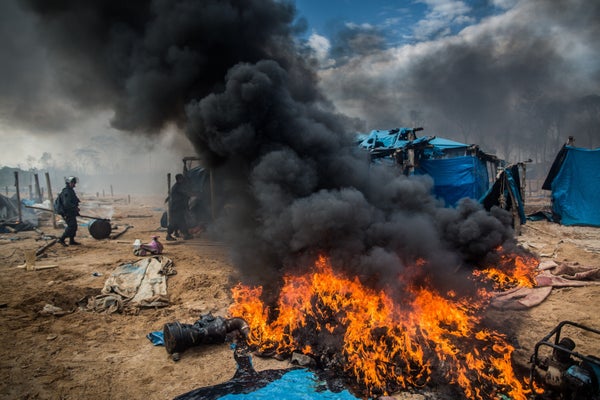
For decades gold miners have pillaged the lush Peruvian Amazon forest of Madre de Dios in search of the precious metal. Now a study reports that illicit mining is sharply on the rise despite local government efforts to curb it—and this is taking a heavy toll on the ecosystem.
In 2012 the Peruvian government announced a slew of legal decrees to defend Madre de Dios—considered the country's biodiversity capital—against miners. Authorities conducted raids, dismantled clandestine camps, and regulated fuel and supply traffic. Despite the crackdown, the total mining area had increased by about 40 percent (to around 170,000 acres) just four years later. According to the most comprehensive analysis to date, the practice—possibly enabled by poor control of the region and greater highway access—extended into at least one of the forest's two national reserves, protected areas where mining is prohibited.
Extracting gold from rock can contaminate the environment. Illegal mining activities often use liquid mercury, a toxic chemical that can drip into the soil or be burned off and released as toxic fumes. And the consequences of illicit mining go well beyond those of the extraction process. Miners often chop down thousands of acres of forest with heavy machinery that scars the landscape.
On supporting science journalism
If you're enjoying this article, consider supporting our award-winning journalism by subscribing. By purchasing a subscription you are helping to ensure the future of impactful stories about the discoveries and ideas shaping our world today.
“You can see those dredging machines sucking silt from the river, hear their engines,” says Raul Tupayachi, a Peruvian biologist at the Carnegie Institution for Science and a co-author of the study. “We hoped our data would show a drop in deforestation rates after the government actions tried to [curb mining] activities,” he says. “But we saw that, in the long run, they haven't really made much of an impact.”
The study, which analyzed satellite images taken between 1999 and 2016 and was published last August in Environmental Research Letters, found an initial decline in deforestation after the government's actions in 2012. By 2013, however, forest loss rates had ballooned. New mines started to appear in the following years. They invaded protected areas such as the Tambopata National Reserve—home to the indigenous Ese Ejja, Quechua and Aymara peoples, as well as brightly colored macaws, giant river otters and jaguars. By 2016 mining operations had felled at least 1,287 acres of forest within the reserve.
William Llactayo, a geographical engineer at Peru's Ministry of Environment, who did not take part in the work, says the study comes at a critical time. If the mining trend continues, Llactayo says, “a lot of these areas will be [irreversibly] degraded in the years to come.”