
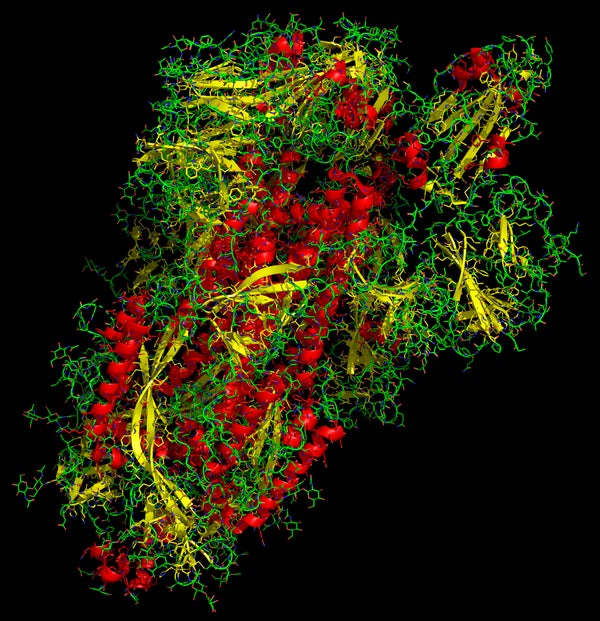
The 20 amino acids that make up the building blocks of a protein contain chemical bonds that vibrate at different frequencies. Markus Buehler, a materials scientist and engineer at the Massachusetts Institute of Technology, coded that information, along with the intricate folding patterns of proteins, so that it could be represented as musical properties such as volume, speed and concurrent melodies (known in music theory as counterpoint).
The researchers then took their work a major step further. By feeding the musical interludes generated from known proteins into a neural network, the team trained the artificial intelligence system to develop novel variations of those rhythms—musical representations of proteins that did not yet exist.
By determining how much the newly generated rhythms could vary from those of the known proteins, Buehler and his colleague Chia-Hua Yu of M.I.T. and the National Cheng Kung University in Taiwan controlled how similar or different the structure of the newly generated proteins could be. The researchers then built atom-by-atom models of the newly designed proteins to determine their stability. Buehler and Yu described their findings this week in APL Bioengineering.
On supporting science journalism
If you're enjoying this article, consider supporting our award-winning journalism by subscribing. By purchasing a subscription you are helping to ensure the future of impactful stories about the discoveries and ideas shaping our world today.
Proteins are part and parcel of all living things, from cell membranes to bone, cartilage, skin and blood. Designing novel proteins could lead to a new generation of disease-fighting drugs, improved enzymes and a host of other high-performing biomaterials.
The function and stability of proteins depend not only on their particular sequence of amino acids but on how the amino acids are assembled into a twisted or pleated three-dimensional structure. It can be challenging to assess these fine details using ordinary algorithms or visualization programs, Buehler contends. A microscope would require multiple, simultaneous magnifications to see all of the substructure in a protein, he notes. In contrast, “our ear can pick up—in one fell swoop—all the hierarchical features” of that substance, he says. “It is an elegant way for our brain to access the information stored in the protein.”
Scientists have used sonification, the process of converting information into sounds, to better conceptualize data in a host of other research areas, from detecting cancer to analyzing space weather. “We believe the analysis of sound can actually help us understand the material world—science—better,” Buehler says.
Translating protein structure into sound bytes is far from arbitrary, notes Buehler, who plays the piano, guitar and drums in addition to composing music. For instance, portions of a protein with a closely packed corkscrew shape (called an alpha helix) are portrayed by a rapid succession of notes, whereas proteins that form a less dense pleated-sheet structure (called a beta sheet) are played more slowly. Overlapping regions in a protein, reflecting its characteristic three-dimensional folds, are represented by counterpoint, or melody against melody.
A protein, with its complex set of folds and many touch points, generates intriguing musical concepts that can assist protein engineers. “The relationship between protein structure and musical notation is very clear and has the potential to identify new proteins for a range of biotechnological applications,” comments Carole Perry, a chemist and forensic scientist who heads a biomolecular materials research group at Nottingham Trent University in England. “It is always exciting to see interplay between the arts and sciences leading to new ideas,” she adds.
To design new proteins using sound and a neural network, a human is not needed to interpret the biological symphony, Buehler acknowledges. “If we want to use the [sonification] in a more artistic way, then, of course, we want to listen and explore,” he says.
“Just like in a painting, the new protein sounds are like a new color palette that could be invented—colors no one has ever seen—but which can now be used to create art,” Buehler says. These sounds include the infamous protein spike on the virus that causes COVID-19 and an actual symphony consisting of sonified amino acids from three proteins.
In follow-up work, Buehler and his colleagues plan to examine the structure of the proteins they have designed to determine how useful those molecules are—either by comparing them with known proteins or testing them in the laboratory. The sonification method could also be improved by adding such information as the bending angles of folded proteins. So the molecular electronica continues.