
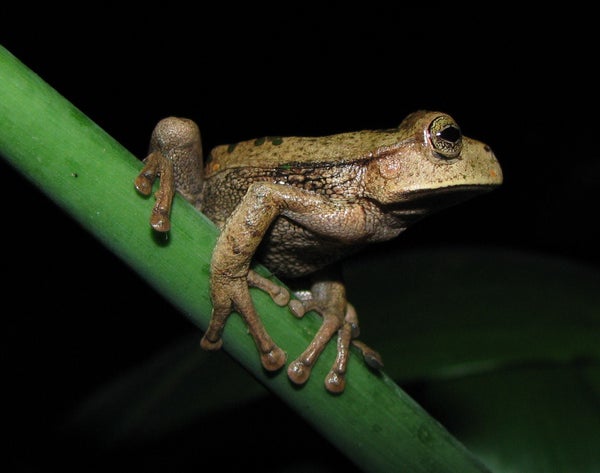
A fungus that kills amphibians by invading their skin has become one of the most destructive invasive species ever recorded, a new research report says.
Batrachochytrium dendrobatidis, a type of chytrid fungus, has caused declines in 500 amphibian species and driven dozens of them to extinction, according to the report, published Thursday in Science. This is the first time scientists have taken global stock of the problem.
“The impact of chytrid fungus is much larger than previously thought,” says Ben Scheele, a postdoctoral fellow at Australian National University who led 40 other researchers in quantifying the devastation. They found the pathogen threatens more species than invasive rodents or cats, dwarfing the effects of other dangerous wildlife diseases such as the notorious white-nose syndrome in bats.
On supporting science journalism
If you're enjoying this article, consider supporting our award-winning journalism by subscribing. By purchasing a subscription you are helping to ensure the future of impactful stories about the discoveries and ideas shaping our world today.
“This should be a clarion call for us all,” says Vance Vredenburg, an ecologist at San Francisco State University who was not involved in the research. “The losses are significant and likely permanent.”
Amphibian Apocalypse
The creeping destruction of B. dendrobatidis (commonly known as Bd) was first noticed in the 1980s, and identified and named in the 1990s. A 2018 genetic study pinpointed its origin to the Korean peninsula, and it spread through global shipping and the amphibian trade. When it hit previously unexposed populations, the disease created an amphibian apocalypse. “The old-timer [biologists] would say, ‘I never saw anything like this,’” recalls Michael Lannoo, a biologist at the Indiana School of Medicine and an expert on the disease who was not involved in the new report.
The spores of the fungus infect amphibian skin, causing it to harden and slough off. Because amphibians drink through their skin, the resulting disease (called chytridiomycosis) disrupts their hydration and electrolyte balance, killing them.
Biologists had watched in horror as entire individual amphibian species succumbed, but no one had ever done a global survey to understand the disease’s full impact. To fill that gap,Scheele and his colleagues pulled together published and unpublished data about amphibian populations from across the globe. They found Bd caused declines in 500 amphibian species, 90 of which are now extinct in the wild. Another 124 have lost more than 90 percent of their population.
The declines varied regionally, hitting Australia and Central and South America particularly hard. Some of this variation is likely related to climate: Bd dies in dry weather but its spores hang around stubbornly in wetter regions, Lannoo says.
Glimmers of Hope
The new study did turn up a few glimmers of hope: for example, 60 affected species show signs of recovering from the worst of the disease, despite its persistence. “We should be feeling good about the fact that some species are able to evolve the right mechanisms to coexist with the pathogen in the wild,” says Dan Greenberg, a doctoral candidate at Simon Fraser University who co-authored an op-ed in Science on the new research with ecologist Wendy Palen, also at Simon Fraser.
But Palen notes that even those hardy amphibians are struggling against myriad other barriers to survival—including climate change, water pollution and habitat loss—and that species hit with Bd are more likely to succumb to these other pressures. Where chytridiomycosis is not wiping out whole species it can be hard to disentangle its impacts from these other factors, says Michael Adams, an ecologist at the U.S. Geological Survey who was not part of the new study. “I suspect there are a lot of cases where there is a low-level effect of the disease—not causing a big die-off, but it’s a drag on the population,” he says.The estimate in the new paper is intentionally conservative, and the researchers acknowledge uncertainty about Bd’s full consequences.
Humans can battle Bd by establishing captive breeding programs for threatened species, says Anne Baker, the executive director of the nonprofit umbrella group Amphibian Ark, which does just that. Some researchers are considering trying to fast-track evolution in captive populations, Baker says, exposing captive frogs and toads to Bd and then breeding the fungus-resistant survivors.
Regulating the amphibian pet trade and improving biosecurity could also staunch the losses—and stop the next destructive pathogen in its tracks. Bd took everyone by surprise, Scheele says, but conservation experts have been quicker to deal with newer threats. In 2016 the U.S. Fish and Wildlife Service banned the import of 201 salamander species in hopes of keeping out the closely related fungus B. salamandrivorans, which has hit Europe’s fire salamander population hard. “We previously had no idea that a pathogen could have such devastating, rapid and severe impacts,” Scheele says. “The quantification of chytrid shows the seriousness of what these pathogens can do.”