

The Defense Department’s pursuit of carbon-free power has led to solar generation at Sun Belt bases from Florida to California, and geothermal systems at installations with suitable geologies.
But what of Alaska? Deep winter there brings less than four hours of direct sun daily, and thawing permafrost—itself driven by climate change—threatens the very existence of some bases.
Eielson Air Force Base may have a solution: micro-scale nuclear energy.
On supporting science journalism
If you're enjoying this article, consider supporting our award-winning journalism by subscribing. By purchasing a subscription you are helping to ensure the future of impactful stories about the discoveries and ideas shaping our world today.
Last month, the Air Force issued a request for proposals to construct a 2.5-megawatt micro-reactor at Eielson to supplement its current 20-MW coal-fired heat and power plant that delivers power across the installation on overhead wires.
An Air Force spokesperson said the planned micro-reactor “is intended to supplement current installation energy sources as a redundant resilience measure to power the base.”
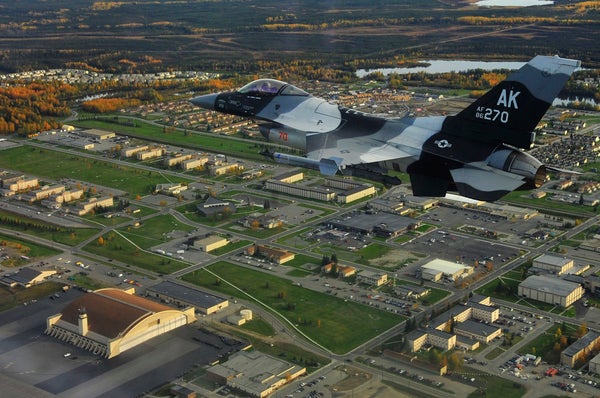
Eielson, established in 1944, provides a critical national security mission. It is home to the Air Force’s 354th Fighter Wing providing “combat-ready air power.” The base, which is 150 miles south of the North Pole, also serves as a “strategic arctic basing option,” according to its website. Eielson recently completed a major expansion to host two new squadrons of F-35 fighter jets. The project required the construction of 36 buildings and 54 housing units.
The base currently relies on a decades-old central heat and power plant requiring between 700 and 900 tons of coal a day, a base spokesperson said in an email. The coal is delivered by rail from the Usibelli coal mine roughly 120 miles southwest of the base. Backup power is provided under contract with the regional electric utility and, if necessary, two diesel generators rated to produce 7.5 MW.
Maj. Kathryn Stuard, the 354th Civil Engineer Squadron operations flight commander at Eielson, said in an email that while the base’s existing power plants have undergone “continuous improvements and upgrades,” additional generation from the micro-reactor “will further enhance energy resiliency and autonomy” at the base.
Unlike Eielson’s existing power plant, the Air Force will not own the new micro-reactor but will buy its electricity under a power purchase agreement with the future builder and owner of the plant. It’s unknown who that will be.
Officials did not provide a cost estimate for the pilot project but said the micro-reactor would be operational by fiscal 2027. The project aligns with the Defense Department’s broader mission to dramatically cut its carbon emissions while improving base resilience to extreme events.
Stuard said the base’s arctic environment is its “primary hazard to energy security,” adding that “extreme cold temperatures and darkness make us more reliant on electricity and heat than other locations.” She said the base has on average two to three power outages each year.
In a statement, Nancy Balkus, the Air Force deputy assistant secretary for environment, safety and infrastructure, said the micro-reactor program “is extremely important to mission assurance and sustainment in the face of climate change and continued national defense threats, and demonstrates the department’s commitment to ensuring our installations have a safe, reliable supply of energy, no matter their location.”
Reprinted from E&E News with permission from POLITICO, LLC. Copyright 2022. E&E News provides essential news for energy and environment professionals.