
On supporting science journalism
If you're enjoying this article, consider supporting our award-winning journalism by subscribing. By purchasing a subscription you are helping to ensure the future of impactful stories about the discoveries and ideas shaping our world today.
Snakes are classified by scientists as limbless squamates (an order that also includes lizards). But nearly 100 million years ago relatives of modern snakes undulated through Cretaceous period waters aided by a paddlelike tail and dragging a pair of short, footless hind legs.
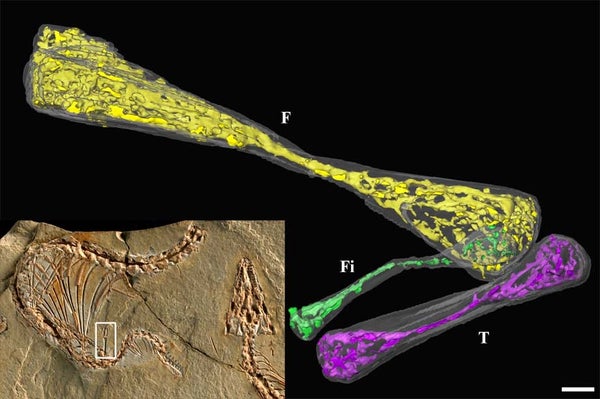
There are few known fossil specimens of these ancient snakes, and only three in which the hind limbs are preserved and visible. In a study published in the January Journal of Vertebrate Paleontology researchers examined a Eupodophis descouensi fossil using synchrotron radiation computed laminography (SRCL). "The uniqueness of the Eupodophis type specimen completely excluded the possibility of invasive investigations," the researchers wrote. SRCL allowed a "virtual exhumation" of bones hidden in the fossil plates, revealing a more complete picture of the snake's anatomy, along with the mechanisms involved in limb regression across evolutionary time.
Eupodophis had a simplistic pelvis and straight, slender femurs, the researchers found. Its tibias were stouter and fibulas more bent than those of most reptiles. Remarkably, it had four tarsals (bones at the very base of the foot) and no metatarsals or phalanges.
Shrunken limbs and missing digits are likely due to changes in the Hox genes, which determine the development of lower body segments. "Loss of limbs also reduces drag and hence the energetic cost of swimming," the researchers wrote. The elongated, serpentine body that allows land snakes to slither through dense grass also serves aquatic snakes in propelling through water. In both cases legs only get in the way.
The new findings could advance the ongoing debate on the phylogenetic status of hind-limbed snakes—whether they are a peculiar sister group or the ur-snake from which all others descend.
—Nina Bai