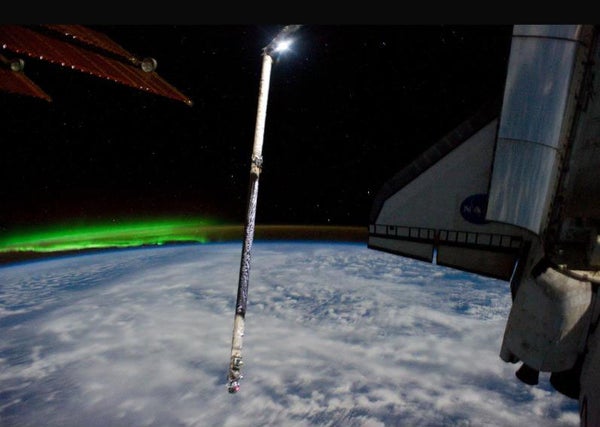
An Astronaut's View of the Southern Lights as the Final Shuttle Mission Wraps Up

This image, taken from inside the International Space Station (ISS), depicts the aurora australis, aka the southern lights.

NASA

Join Our Community of Science Lovers!


On supporting science journalism

If you're enjoying this article, consider supporting our award-winning journalism by subscribing. By purchasing a subscription you are helping to ensure the future of impactful stories about the discoveries and ideas shaping our world today.


This image, taken from inside the International Space Station (ISS), depicts the aurora australis, aka the southern lights.

Doug Hurley, pilot of the docked shuttle Atlantis, who witnessed the greenish glow from the multi-windowed cupola that was carried up via shuttle and added to the ISS last year, told the press that it was "the best [aurora] I've seen in my two spaceflights."

In a 2005 Scientific Americanarticle about the asymmetry of the Earth's auroras, Sarah Graham explained that the southern lights—and their more famous Northern Hemisphere cousin, the aurora borealis, or northern lights—"result from the interaction between Earth's magnetic field...and energized particles from the solar wind that emit light in the upper atmosphere."

On the day this photo was taken, the STS 135 and Expedition 28 crew members were wrapping up NASA's final space shuttle mission. Atlantis is docked on the right, and the Orbiter Boom Sensor it uses to check its reentry tiles hangs over the center. The solar array at left is a small sliver of the 3,570 square meters of solar panels that generate up to 120 kilowatts of power for the ISS.

Atlantis is scheduled to land at the Kennedy Space Center at 5:56 A.M. Eastern time Thursday.

—Lauren F. Friedman

It’s Time to Stand Up for Science

If you enjoyed this article, I’d like to ask for your support. Scientific American has served as an advocate for science and industry for 180 years, and right now may be the most critical moment in that two-century history.

I’ve been a Scientific American subscriber since I was 12 years old, and it helped shape the way I look at the world. SciAm always educates and delights me, and inspires a sense of awe for our vast, beautiful universe. I hope it does that for you, too.

If you subscribe to Scientific American, you help ensure that our coverage is centered on meaningful research and discovery; that we have the resources to report on the decisions that threaten labs across the U.S.; and that we support both budding and working scientists at a time when the value of science itself too often goes unrecognized.

In return, you get essential news, captivating podcasts, brilliant infographics, can't-miss newsletters, must-watch videos, challenging games, and the science world's best writing and reporting. You can even gift someone a subscription.

There has never been a more important time for us to stand up and show why science matters. I hope you’ll support us in that mission.

Thank you,

David M. Ewalt, Editor in Chief, Scientific American

Subscribe