
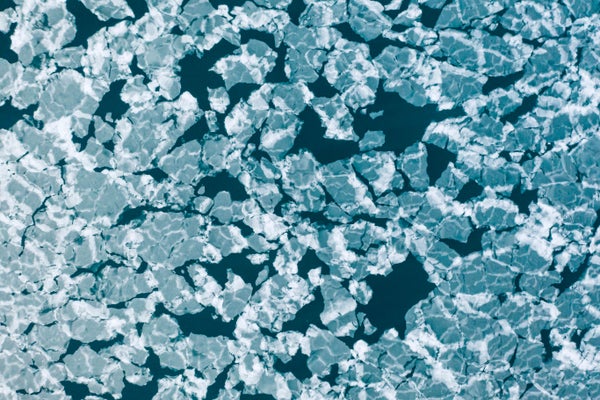
CLIMATEWIRE | The Arctic could see ice-free summers as early as the 2030s, scientists say. That’s as much as a decade earlier than previous studies have suggested.
The findings, published Tuesday in the scientific journal Nature Communications, warn that even aggressive global climate action may not be enough to stop it.
Previous studies have found that faster efforts to curb greenhouse gas emissions could ward off the onset of ice-free summers. But the new research suggests that they’re now all but inevitable.
On supporting science journalism
If you're enjoying this article, consider supporting our award-winning journalism by subscribing. By purchasing a subscription you are helping to ensure the future of impactful stories about the discoveries and ideas shaping our world today.
The research team, led by Yeon-Hee Kim of Pohang University of Science and Technology in South Korea, examined satellite observations of Arctic sea ice collected between 1979 and 2019. The Arctic is currently warming as much as four times faster than the global average, and sea ice has been rapidly declining for decades.
The researchers then compared these observations with computer model simulations of Arctic sea ice declines over the same period. The use of simulations allowed the scientists to investigate the influences of individual factors including greenhouse gas emissions, other forms of air pollution and natural climate cycles on Arctic melting.
They found that greenhouse gases are clearly driving the sea ice declines, not only during the summer months but all year round.
But they also found that climate models tend to underestimate the rate at which sea ice is vanishing from the Arctic. So the researchers corrected those trends in the simulations. Then they used the models to make projections for the future, looking at a variety of hypothetical climate action scenarios.
The new projections suggest that ice-free summers likely would commence somewhere between the 2030s and the 2050s, depending on how quickly emissions decline in the coming years. That’s even with stringent and immediate efforts to reduce greenhouse gas emissions.
That’s a departure from previous, uncorrected model projections, which found that ice-free summers could be averted with swifter climate action.
Faster action still makes a difference. The study found that slower climate action would produce longer ice-free periods, potentially lasting from June to October in the worst cases. On the other hand, the swiftest efforts to cut greenhouse gas emissions could limit the ice-free period to the month of September.
Still, scientists warn that the planet is likely to experience stronger climate consequences as Arctic sea ice dwindles. Bright, shiny sea ice helps reflect sunlight away from the planet. As it disappears, the Arctic warms even faster.
And studies suggest that rapid Arctic warming has ripple effects elsewhere around the planet. The warming alters the Earth’s atmosphere in ways that scientists believe can affect extreme weather events and other climate patterns in other parts of the world, including Europe and North America.
Ice-free summers also will open up new shipping routes through the Arctic. This could create additional complications for the region, including an increase in ship-related pollution and potential new geopolitical tensions around access to shipping paths and natural resources.
Reprinted from E&E News with permission from POLITICO, LLC. Copyright 2023. E&E News provides essential news for energy and environment professionals.