
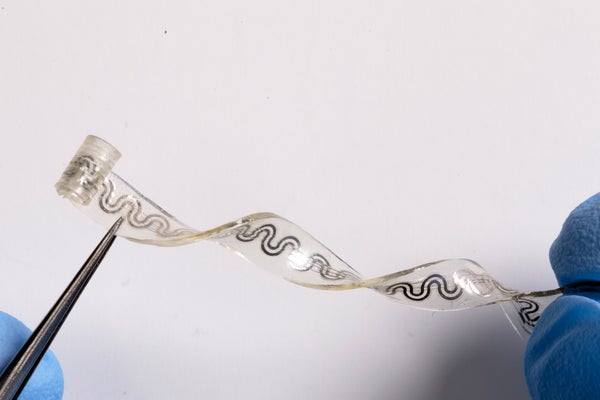
“Ice it”: that’s the age-old commonsense advice to quickly soothe pain. Despite its effectiveness, the low-tech treatment is limited by its bulk and imprecision. But that seemingly crude solution is now demonstrating potential as an alternative to opioids and other pain-relieving drugs. That alternative comes in the form of an implantable device—an ultraminiaturized ice pack applied directly to a single nerve. Implanted in rats, the device produced pain-relieving effects, suggesting its utility for treating people for postsurgical pain or some other forms of localized pain.
“We know there’s a lot of healing power in cooling,” says Theanne Griffith, a neuroscientist at the University of California, Davis, who was not involved in the work. “It has been used for centuries to treat pain.”
The idea of an implantable cooling device is not new, but existing ones are big and clunky. They can damage tissue and need to be surgically removed. The new device, engineered by researchers at Northwestern University and their colleagues, is made of a soft, stretchy nervelike material called poly(octanediol citrate), or POC. A few weeks after implantation, the dissolvable material simply melts away into the body. “Local cooling is an effective analgesic,” Griffith says. “Conceptually, this shows you can apply this long-standing knowledge in a really innovative way.” The study, co-led by John Rogers of Northwestern, appeared in Science on June 30.
On supporting science journalism
If you're enjoying this article, consider supporting our award-winning journalism by subscribing. By purchasing a subscription you are helping to ensure the future of impactful stories about the discoveries and ideas shaping our world today.
The system couples microfluidics, tiny serpentine tubes through which liquid flows, with an electronic interface that measures and controls temperature, and hence nerve activity, via remote control, perhaps one day allowing a patient to adjust the setting. The cooling comes from a chemical contained in the tubes called perfluoropentane (PFP), which has already been approved for biomedical use as a contrast agent for ultrasound. Another compartment contains dry nitrogen. When the two chemicals meet, they produce the desired chill. Just a few millimeters long, the device enwraps a tiny section of a single nerve like a cuff, directly cooling it. There may be no need for a second surgery to remove the device because it later dissolves in the body.
The researchers implanted the device around rats’ sciatic nerve to test its analgesic potential. It rapidly cooled to five degrees Celsius, effectively halting signals from the nerve, which resumed upon rewarming. The researchers then tested the device in rats with spared nerve injury (SNI), an animal model of chronic pain that damages but does not kill a nerve. Three weeks after SNI surgery, two control rats demonstrated greater sensitivity from a poke to the paw. Three rats that received the cooling cuff implant as part of SNI surgery had the damaged nerve “treated” with cooling down to 10 degrees C. That increased the pain sensitivity threshold by sevenfold, restoring it back to presurgery levels.
“The method is cool—no pun intended,” says Allan Basbaum, a pain researcher at the University of California, San Francisco, who was also not involved in the study. “It’s provocative; it’s interesting. But there are still many questions as to the utility of it in a clinical context.”
These tests in rodents need further study, researchers say, because the treated nerve bundle contains nerve cells that carry not just pain but other sensations, as well as signals that are transmitted by motor and sympathetic nerves. If all of those nerves are silenced, that could have consequences such as numbness—which people report as quite unpleasant—or motor weakness. “There’s a lot happening when you cool the entire nerve,” Basbaum says.
“On the bright side, most, if not all, neuropathic pain is driven by abnormal nerve activity,” he adds, referring to the type of pain caused by nerve damage. “And local anesthetics are very effective. So theoretically, if you cool the nerve to the point of blocking all conduction, you’re effectively doing what the local anesthetic does.”
“My one big question [is] ‘What does that rat actually feel?’ Reduced pain? Numbness?” Griffith says. “That’s going to influence how it can be used in people.” Far more sophisticated behavioral tests in rodents will be needed to answer such questions. “Pain in humans is complex; it’s more than the initial [nerve] signaling,” Griffith adds. “There’s central [nervous system] processing, emotional processing. It would be nice to see assays that get to the higher-level perception of pain.”
The rationale behind the device rests on an “interesting property” exhibited by mammalian nerves: the fact that their level of functioning depends on temperature, says Matthew MacEwan of Washington University in St. Louis, a co-author of the new study. When cooled enough, nerves stop firing signals. That is exactly what Rogers, MacEwan and their colleagues were looking for. “We wanted to find a way to deliver mild nerve cooling as a means of shutting down and blocking painful stimuli,” he says.
The study’s authors suggest that the device could be implanted in people during a surgery that already involves a specific nerve, such as an amputation, which often results in an excruciating condition called phantom limb pain. But MacEwan also envisions its use for more common surgeries, such as knee replacement.
Safety issues still must be explored. A low temperature could potentially cause damage to nerves over time. “We did not see any deleterious effect on the nerve fiber,” MacEwan says, “but that’s an area we want to further explore—to extend the duration of cooling and make sure the delivery is safe and reversible.”
Griffith adds, “You’d want to see how much cooling we could deliver before we damage the nerve. I’m not sure, but five degrees [C] is pretty cold.”
Basbaum says that the technology, though promising, needs further development to look at its potential side effects, as well as how it might be used in other applications. “We’re not there yet,” he says. “This is not replacing morphine.”