
Ancient Egyptians might have understood an occupational hazard of today’s office workers: an achy back and neck. That’s according to an analysis of the skeletons of scribes, who would have sat hunched over for long periods of time.
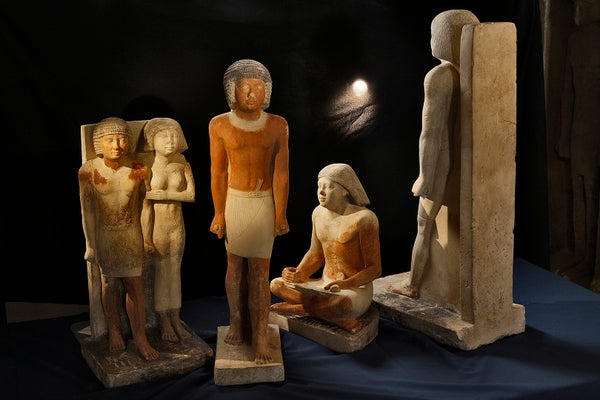
Just 1 percent of the population was literate when the nation’s pyramids were being built, researchers say. Scribes in ancient Egypt were privileged members of society who often performed a range of administrative roles and secretarial tasks, such as keeping official records, managing households and recording taxes. Art and writing from the time suggest that scribes often sat cross-legged or in a kneeling position for extended periods while they wrote with thin, brushlike rush pens (and later reed pens), recording important notes on sheets of papyrus, pottery notepads called ostraca or wooden boards. Instead of using extravagant hieroglyphs, which tended to be inscribed in monuments by specialists, they typically wrote in hieratic cursive—a simpler script more suited to everyday note-taking.
Although this work was not considered physically demanding—and was likely a sought-after job at the time—a study now published in Scientific Reports suggests that continuously adopting these repetitive writing positions wreaked havoc on scribes’ skeletons. After examining dozens of scribes’ remains, the researchers found evidence of strain and overloading at joints in the knees, metacarpal bones in the fingers and thumb, ankles, shoulders, lower jaw, right collarbone, neck and back. The skeletons often also had osteoarthritis in their right knee, which the study’s authors theorize came from repeatedly putting their right leg in a squatting position to write.
On supporting science journalism
If you're enjoying this article, consider supporting our award-winning journalism by subscribing. By purchasing a subscription you are helping to ensure the future of impactful stories about the discoveries and ideas shaping our world today.
“The published paper is actually the first insight into the question of the physical activity of scribes,” says study co-author Veronika Dulíková, an Egyptologist at the Czech Institute of Egyptology.
Dulíková and her colleagues analyzed the skeletal remains of 69 male individuals, 30 of whom were known to be scribes because of written documents from their tombs. All of them were buried in the necropolis at the Abusir pyramid site in Egypt, between 2700 and 2180 B.C.E. Overall, the team examined 1,767 skeletal traits and compared these with bones from the remains of ancient Egyptians who weren’t scribes.
Compared with the nonscribes’ remains, there were statistically significant signs that the writers’ joints were worn down throughout their lives—evidence, the scientists claim, of occupational strains from these individuals sitting cross-legged or kneeling with their head bent forward much of the time. Just as sitting at a desk and leaning forward to look at a screen can injure your spine and neck, ancient Egyptian scribes would likely have experienced comparable body stresses from hunching over the papyrus for too long.
“It seems that prolonged sitting in an inappropriate position still affects the human skeleton in the same way,” says study co-author Petra Brukner Havelková, an anthropologist at the National Museum in Prague. “It can cause degeneration of the spine, arthrosis of the joints and subsequent pain.”
The new paper “does certainly add a sense of physical sensation to the life of the scribe,” says Hana Navratilova, an Egyptologist at the University of Oxford, who was not involved in the work. Navratilova notes that additional data would be needed to strengthen the research, but she also emphasizes the value of being able to move our understanding of ancient Egyptian people’s lives beyond artistic depictions. “Now we’re stepping out of it,” she says, “and tracking down the individual working positions of the scribes ... [to find] a corresponding impact on the bodies that performed that kind of activity.”
Joe Wegner, a curator of the Egyptian Section of the University of Pennsylvania Museum of Archaeology and Anthropology, says that the “connections between the skeletal samples and the historical record for the identity and vocation of the individuals at Abusir is a unique opportunity to look at multiple lines of evidence.” He would also like to see a bigger dataset. The study’s authors next aim to confirm their results by looking at comparable remains from a different burial site.
“It is ironic that the Egyptians often talked about how being a scribe was the most desirable of professions,” Wegner adds, “but apparently even that came with some health risks!”