
If you look across cultures and through history, there’s a deity for pretty much anything. The sun, ocean, harvest, lightning, love, poetry, all the good stuff. For some of us at Scientific American, our favorite is the ancient Egyptians’ Thoth, god of science, knowledge, wisdom and writing. Thoth is often depicted as a baboon—making him the only god in the pantheon whose animal representative was not native to Egypt. Egyptologists have wondered where, exactly, the mummified baboons buried with pharaohs came from and why a certain species was considered sacred. Now primatologist Nathaniel J. Dominy discusses how the behaviors of Papio hamadryas fit into ancient Egyptian theology and how isotope analysis of these baboons points to the location of the lost kingdom of Punt. It’s a delightful story that may make you want to hoot at the rising sun.
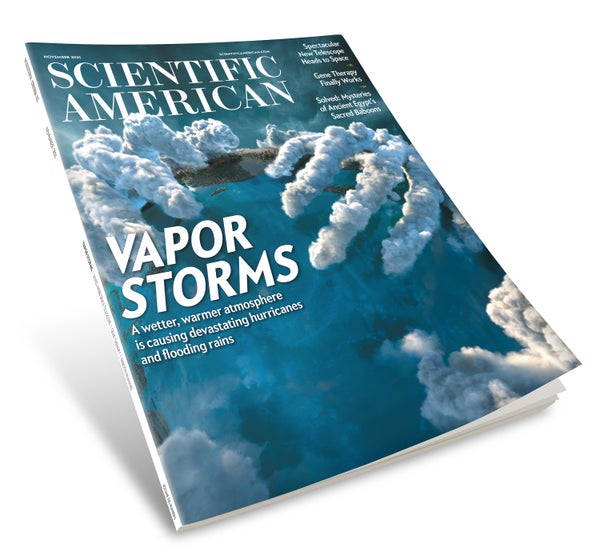
In our cover story this month, climate scientist Jennifer A. Francis shows how water vapor—an underappreciated greenhouse gas—is causing disastrous floods and extreme weather around the world. Vapor storms are dumping more rain more quickly, energizing thunderstorms and hurricanes, and making summer days and nights more dangerously humid. Francis, who is a member of Scientific American’s advisory board, calls for better instrumentation to measure temperatures below the sea surface, which should improve forecasts of hurricane strength and rainfall. (For the opposite end of extreme weather caused by the climate emergency, see our Graphic Science piece on extreme droughts.)
The James Webb Space Telescope is finally—we hope!—going into space this year. It was initially scheduled to launch in 2007 but was pushed back by problems with the contractor, budget overruns, human error and the general complications of creating a spaceship with a tennis-court-size sun shield that will orbit 1.5 million kilometers from Earth. NASA photographer Chris Gunn has been capturing the painstaking progress of the mission as JWST was being built and tested, and seeing his gorgeous pictures with text from senior editor Clara Moskowitz is a great way to anticipate liftoff in December (again, we hope).
On supporting science journalism
If you're enjoying this article, consider supporting our award-winning journalism by subscribing. By purchasing a subscription you are helping to ensure the future of impactful stories about the discoveries and ideas shaping our world today.
In another hopeful story, sustainable food expert Raj Patel takes us on a tour of communities that are turning to agroecology, a practice that integrates social science, ecology, soil health, community building, and more into traditional agricultural science. The United Nations hosted a summit on food systems in September that excluded agroecology, and Patel makes a strong case that current practices are not sustainable and that agroecology is necessary to end world hunger.
The idea of editing genes to repair genetic diseases has seemed promising for decades, but the approach failed when several young people died in clinical trials. On a personal note, the day the news broke in 2003 that an experimental treatment for severe combined immunodeficiency (SCID, or “bubble boy disease”) had caused leukemia in some of the children, a group of science writers in Washington, D.C., attended a previously scheduled happy hour, and it was the glummest happy hour ever. Many of us were covering the trial and were devastated that it had failed. Now researchers have figured out how to deliver gene therapy more safely and for more types of diseases, including cancer. Our special Innovations In report, starting here, explains how the field has matured, what the successes are so far, and how to manage hope and hype when people are desperate for cures.