
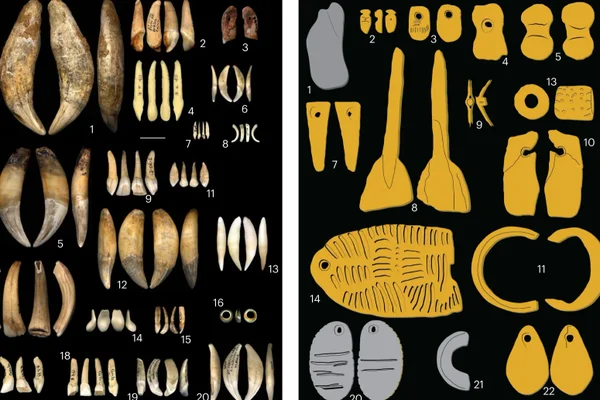
Bling isn’t a modern invention; humans have been wearing what anthropologists call personal ornamentation for tens of thousands of years. And the distinct ways prehistoric people adorned themselves can illuminate long-vanished cultures. A new study has used more than 100 types of beads, made of shells, ivory and other materials, to determine that there were at least nine distinct cultural groups living in the then frozen landscapes of Europe between 34,000 and 24,000 years ago.
These cultures were so distinct that you would have been able to tell them apart just by the embellishments on the bodies of their members, even if those people had similar genetics. In fact, in some cases the new study pointed to culture being the stronger factor. “We've shown that you can have two [distinct] genetic groups of people who actually share a culture,” says the study’s lead author Jack Baker, a doctoral candidate in prehistory at the University of Bordeaux in France.
The study, published on Monday in Nature Human Behaviour, analyzed 134 types of beads from 112 sites across Europe—from Paviland in Wales to Kostenki in Russia—that dated back to a prehistoric ice age between 34,000 and 24,000 years ago. A few of the trinkets were found in burials, but most were from ancient dwelling sites. These personal ornaments were surprisingly diverse: ivory fashioned into owl-like shapes, beads carved to look like human breasts, amber pendants, shells with holes in them and a wide variety of animal teeth. Using these and other types of adornments, the researchers identified nine distinct cultural groups of hunter-gatherers that were present during this period.
On supporting science journalism
If you're enjoying this article, consider supporting our award-winning journalism by subscribing. By purchasing a subscription you are helping to ensure the future of impactful stories about the discoveries and ideas shaping our world today.
“In the East, for example, they were very, very much more focused on ivory, on teeth, on stone,” Baker says. But on the other side of the Alps, people would have adorned themselves with “really relatively flamboyant colors: reds, pinks, blues, really vibrant colors.” If you were to see one person from each group, he adds, “you could say, ‘He's from the East, and he's from the West,’” at a quick glance.
But one of the study’s main findings was that distance and isolation only accounted for a surprisingly small difference between the ornaments that the various groups wore in necklaces, bracelets and other trinkets, Baker says.
This suggests other factors were at play, possibly including the availability of materials, cultural sharing among groups and an individual’s social status. The study found that differences were more pronounced when it came to burial sites, compared with places where people lived. “Cultural differences crystallize better around things like funerary rites,” Baker says, adding that this highlights the importance of taking site usage into context when investigating ancient human behavior.
Marjolein Bosch, a paleolithic zooarchaeologist at the Austrian Archaeological Institute, who wasn’t involved in the new study, says it “clearly highlights differences in the range of ornamental diversity between these two archaeological contexts and points toward different narratives in cultural expression in the realms of life and death.”
The finding of nine distinct cultures broadly matched paleogenomic data that identified various groups that were present in Europe during that time—but there were exceptions. Based on the artifacts, the researchers also identified one apparently distinct culture for which there are currently no genetic data. “This study has shown really nicely that genetics does not equal culture,” Baker says.
The new study “tells us that there is a right and a wrong way to study and report about identity in the past.... One of the dangerous problems with ancient genomics is that genes aren’t proxies for group or individual identity; our identities are shaped by our cultural milieu,” says Sheela Athreya, a professor at the department of anthropology at Texas A&M University, who also was not involved in the new research. Building both individual and group identity is an “enormously complex human process.”
For Baker, the research also highlights that—even during an ice age, when environmental conditions were “horrendous”—“we still flourish, and we still create things that are beautiful to adorn ourselves.”