
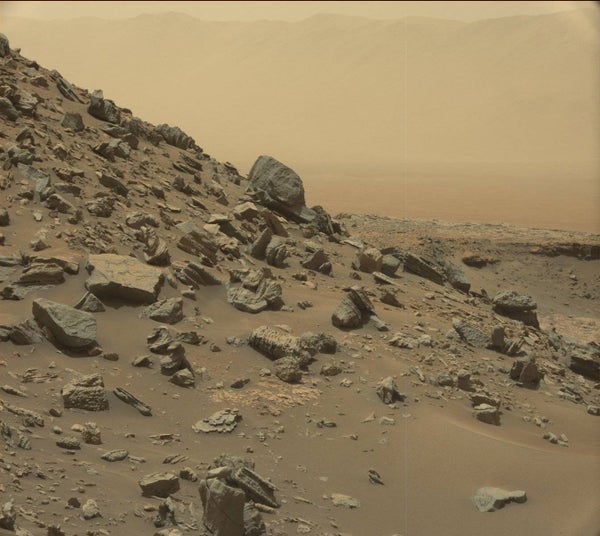
SAN FRANCISCO—Parts of Mars were capable of supporting life as we know it for lengthy stretches in the ancient past—perhaps hundreds of millions of years at a time, new observations by NASA's Mars rover Curiosity suggest.
Since it landed inside the Red Planet's Gale Crater in August 2012, Curiosity has studied a number of different rocks over an elevational range of about 650 feet (200 meters), which represents a time span of tens of millions to hundreds of millions of years.
The rovers' analyses indicate that the environment within Gale Crater changed considerably during this period, but never in a way that would preclude life from forming or surviving, mission scientists said today (Dec. 13) during a news conference here at the annual fall meeting of the American Geophysical Union (AGU). [The Life on Mars Search: Photo Time Line]
On supporting science journalism
If you're enjoying this article, consider supporting our award-winning journalism by subscribing. By purchasing a subscription you are helping to ensure the future of impactful stories about the discoveries and ideas shaping our world today.
"For that entire history [of Mars], it seems to have been favorable" for life, said Curiosity science team member (and former project scientist) John Grotzinger, a geologist at the California Institute of Technology in Pasadena.
Curiosity's observations—made by drilling into rocks, then studying the resulting samples—had already allowed scientists to determine that Gale Crater harbored a potentially habitable lake-and-stream system billions of years ago. (Like the rest of Mars, the area is dry today, at least on the surface.)
The new results paint a more detailed picture of that environment and how it changed over time. The results incorporate additional analyses that Curiosity has performed as it climbs the foothills of Mount Sharp, which rises 3.4 miles (5.5 kilometers) into the sky from Gale Crater's center.
The initial observations, made by Curiosity at lower elevations, suggest that the lake was first composed of fresh, neutral-pH water. That water got a bit more acidic over time, and then a bit saltier. The lake system probably dried up at times and then filled back in again, as the groundwater level rose, Grotzinger said.
But, despite all these changes, the area remained hospitable to microbial life, he added. (Simple organisms could have persisted in groundwater even during the lake system's "dry" stages.)
"This is all very good for habitability over long periods of time," Grotzinger said.
Furthermore, Curiosity's analyses show a complexity of minerals at the rover's various drill sites, from clays and magnetite lower down to hematite higher up. The six-wheeled robot also detected boron in Gale Crater, marking the first time this element has been discovered on Mars.
Again, this is all good news for ancient Mars' habitability, mission team members said.
"Variations in these minerals and elements indicate a dynamic system," Grotzinger said in a statement. "They interact with groundwater as well as surface water. The water influences the chemistry of the clays, but the composition of the water also changes. We are seeing chemical complexity indicating a long, interactive history with the water. The more complicated the chemistry is, the better it is for habitability. The boron, hematite and clay minerals underline the mobility of elements and electrons, and that is good for life."
Some samples also showed abundances of silica, which here on Earth is great at preserving ancient microbes, Grotzinger said. This find, of course, does not suggest that organisms have ever survived on Mars, but it could aid the planning of future life-hunting missions such as NASA's 2020 Mars rover, Grotzinger said.
"I think this is a tremendously exciting discovery," he said.
Curiosity will continue climbing up Mount Sharp's lower reaches, further fleshing out scientists' understanding of the ancient Martian environment and how it changed over time. The rover is in good health, though a problem with Curiosity's drill that cropped up earlier this month persists, mission team members said today.
Copyright 2016 SPACE.com, a Purch company. All rights reserved. This material may not be published, broadcast, rewritten or redistributed.