
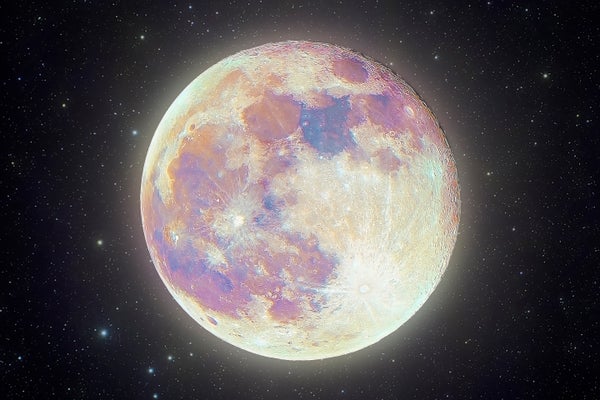
The moon is Earth’s closest neighbor in space and the only extraterrestrial body humans have visited. Yet scientists are still unsure exactly when a Mars-size meteorite slammed into early Earth, causing our natural satellite to form from the debris. Lunar rock samples put the event at 4.35 billion years ago, but planet formation models and fragments of zircon from the moon’s surface suggest it happened at least 4.51 billion years ago.
A new study published in Nature offers a way to explain that 150-million-year gap. Computer modeling and analysis of previous research suggest the 4.35-billion-year-old rock samples may date not back to the moon’s formation but instead to a later event in which the moon temporarily heated up, causing its surface to melt and then crystallize.
The moon’s elliptical orbit is slowly getting more distant from Earth. As the moon moves it is squeezed and stretched by Earth’s gravity, resulting in what is known as tidal heating events—one of which most likely happened 4.35 billion years ago. This early moon would have looked like Jupiter’s moon Io, says the study’s lead author Francis Nimmo, a planetary scientist at the University of California, Santa Cruz. “It would have had volcanoes all over its surface,” he says. This event would have also erased lunar impact basins caused by meteorite strikes, which researchers use to estimate age.
On supporting science journalism
If you're enjoying this article, consider supporting our award-winning journalism by subscribing. By purchasing a subscription you are helping to ensure the future of impactful stories about the discoveries and ideas shaping our world today.
The difference of 150 million years matters a lot to scientists, Nimmo says, especially for learning more about the early Earth. “The moon is moving away from Earth, and the rate at which that happens depends on what Earth was like,” he says. “Was it solid? Was it liquid? Did it have an ocean? Did it have an atmosphere?” For instance, very early Earth probably didn’t have an ocean—or it would have pushed the moon away too fast. The moon’s formation time is crucial to these calculations, and more complex models of tidal heating and the mineralogy involved could help refine our understanding.
“No previous study has synthesized all the available evidence comprehensively,” says Yoshinori Miyazaki, a geophysicist at the California Institute of Technology, who wasn’t involved with the study. “This paper provides a better view in resolving the discrepancies between different age estimates.”
Current hypotheses for when Earth and the moon formed, which put the date at anywhere from 30 million to 150 million years after the sun’s birth, suggest vastly different scenarios for planet formation. “Resolving these uncertainties is essential for constructing a consistent picture of solar system history,” Miyazaki says.